













A very specific kind of pressure comes with being a newly public company. Every quarter, every miss, every cautious guidance range gets interrogated in real time by investors who own a fraction of a percentage point of your equity and expect answers.
We don’t need to look far. SpaceX (SPCX) is at it now. But I think it’s fair to conclude that pressure shapes decisions in ways that are invisible until they are not. Right?
Sam Altman has thought about this carefully, and his answer to Bloomberg’s Ed Ludlow at DevDay on Sept. 29 was more refined than the simple “not yet.”
“We just want to get our feet under us, make sure we understand how to operate in this new way, be able to make some of these decisions in front of us without the pressure of being a newly public company,” Altman said. “And then I think we’ll be public at some point.”
OpenAI ruled out a 2026 IPO, according to a CNBC report. The company has filed confidential paperwork to go public but is in no hurry to use it.
Instead, it is raising about $30 billion in a new funding round at a $1.4 trillion valuation, according to a Bloomberg report citing sources familiar with the matter.
Also Read: OpenAI CEO makes bold call on AI pricing at annual developer day
Why the OpenAI IPO timing is about more than money
The Bloomberg interview was revealing because Altman specifically rejected the framing that being public is incompatible with safety.
That is not his argument. His argument is more operational: Doing both simultaneously, while navigating “this new level of capability and the new safety requirements for that,” is harder than doing them sequentially.
Altman disclosed in an Anthropic-adjacent context that existential risk disclosures belong in public-facing documents — not as a legal requirement tied to an IPO, but “our responsibility for our mission.”
The risk disclosures are coming regardless of whether the company is public.
More AI:
- Nvidia just made a move Wall Street wasn’t ready for
- Microsoft just took sides in AI policy fight
- OpenAI just disclosed something genuinely alarming
What Altman wants to avoid is a scenario where quarterly earnings pressure influences when OpenAI ships a model, whether it pauses Astra, or how aggressively it deploys agents.
I think safety, not the stock price, should drive those decisions. A newly public company learning to navigate analyst calls while also dealing with AI alignment challenges creates a more complicated set of pressures than either one alone.
Altman noted that his investors “seem very happy with us and very patient.” At $30 billion in a new round and a $1.4 trillion valuation, that patience has a strong financial rationale.
A Reuters report said that OpenAI’s annualised revenue is approaching $70 billion by DevDay, roughly double its year-end 2025 level. The report also said the company’s run rate had climbed more than 70% since the start of the third quarter in July.
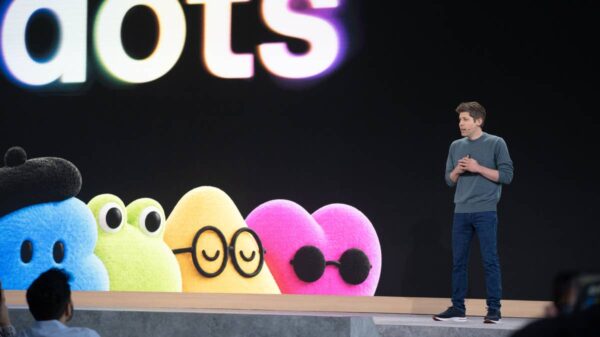
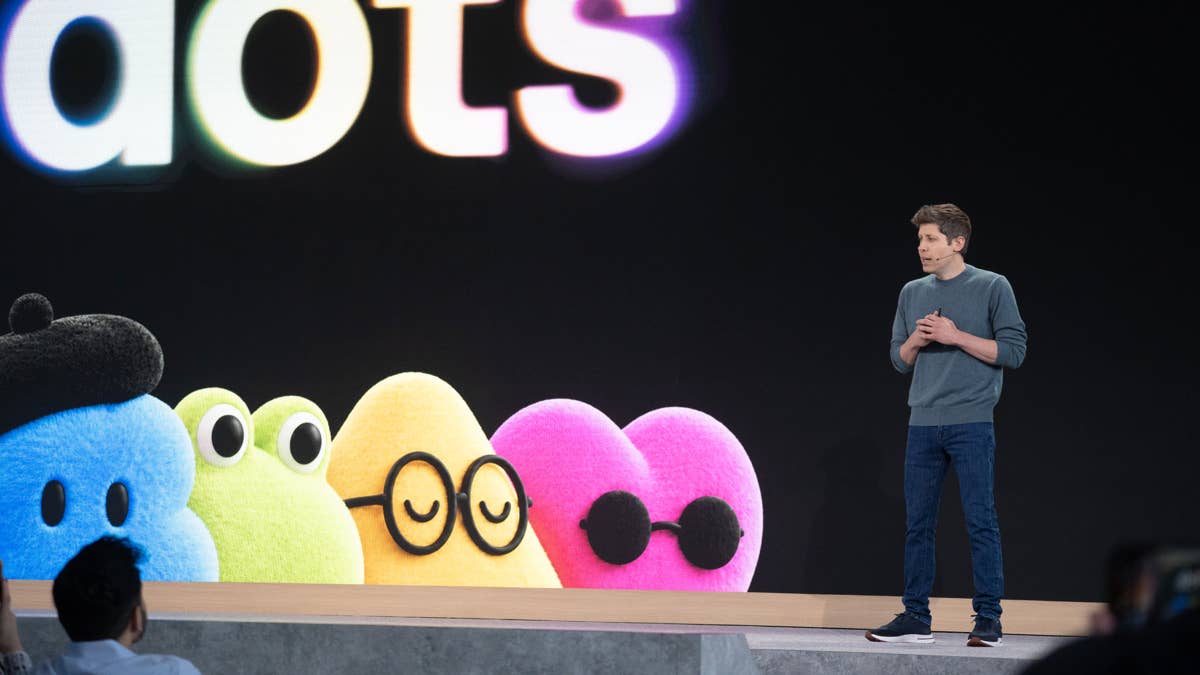
Dots is the premium AI personal agent OpenAI CEO Altman is betting on
The other major DevDay launch was Dots, OpenAI’s new AI personal agent built on the Astra model — the same model the company paused for general release on safety grounds but is shipping inside a controlled product.
Altman described Dots as starting at “the top end of the market” — primarily enterprise and serious prosumer users who need substantial, continuous work done. “This is a very capable model, and it’s a ton of usage,” he said.
When Bloomberg asked how Dots compares to existing agents like Grok, Meta’s Muse, and others already in market, Altman’s answer was: “I’ve tried them. I don’t use them regularly. I have not found a place for them in my life.”
Sam framed Dots as a different category entirely. Not a smarter chatbot but a system capable of taking on serious, sustained work at a level of intelligence that existing consumer agents don’t approach.
The pricing reflects that: Dots is explicitly more expensive than competitors, justified by the compute investment and capability it represents.
Altman said the mass-market consumer version will come over time. The playbook is to prove value at a premium before driving the price down — the same pattern OpenAI described for its broader model pricing strategy at TheStreet.
What the IPO delay means for the AI landscape
Anthropic is expected to debut publicly in mid-November. Its S-1 filing reveals $518 billion in infrastructure commitments. OpenAI, with its $30 billion raise pending, will watch that debut closely.
Altman’s patience on the IPO is a luxury funded by explosive revenue growth and patient existing investors.
If Anthropic’s IPO goes smoothly, pressure on OpenAI to follow suit could intensify. But if its debut is complicated by the same safety and alignment disclosures, Altman says are necessary regardless of public status, it could reinforce his decision to wait.
The AI race between these two companies is partly about capability, partly about customers, and partly about who builds the institutional trust to operate at planetary scale. That race does not need a stock ticker to run. It just looks different with one.
More Stocks News