




















Every industry gets one moment when the crowd changes its mind all at once.
It gets written up later as strategy. Up close it looks more like relief, a room full of executives who spent three years promising one future finally allowed to say out loud that the math never worked. The write-down gets forgiven because everyone is taking one.
The car business had that moment last fall.
The $7,500 federal clean vehicle credit expired on Sept. 30, 2025, and the demand that had been yanked forward into the third quarter stopped showing up. Battery-electric vehicles made up roughly 6% of U.S. sales in the second quarter of this year, down from a peak near 11% during the pre-deadline scramble, according to Cox Automotive figures cited by Inside Climate News.
What followed was one of the fastest strategy reversals American manufacturing has produced. At least 18 automakers have canceled, delayed, or scaled back electric plans in the U.S., reported Autoblog. Ford (F) converted a Tennessee plant built for EVs into a gas truck plant. General Motors (GM) idled battery lines in Ohio and Tennessee.
Almost nobody wanted to be caught holding an electric product plan.
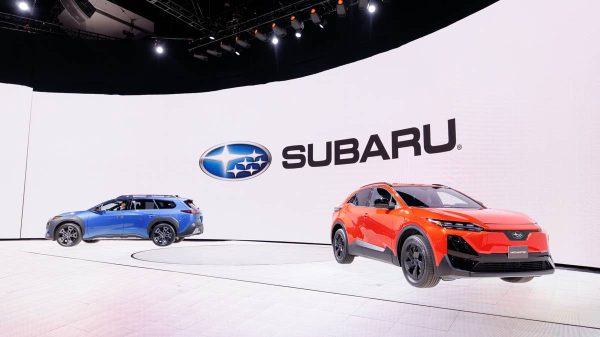
Subaru (FUJHY) kept building one anyway.
How the EV pullback reshaped every showroom
The retreat was not subtle, and it was not cheap. The charges landed on balance sheets fast enough that most buyers never registered them, but they explain why the crossover a family shopped in 2024 may not exist in 2027.
Here is what walking away actually cost, and what one holdout did instead.
- Ford took a $19.5 billion charge in December as it scaled back EV programs, according to Steel Market Update.
- General Motors recorded $7.6 billion in EV-related charges in the second half of 2025 and another $1.1 billion in the first quarter of 2026, per the same tally.
- Honda dropped its 0 Series SUV, 0 Series Saloon, and the Acura RSX from U.S. plans, reported Autoblog.
- Subaru finished among the small group of brands posting EV sales gains in the first half of this year, according to Cox Automotive data.
That last bullet is the one that stopped me. I went back through Subaru of America’s monthly releases to check it, because a gain in this market reads like a typo.
Honda chief executive Toshihiro Mibe framed the industry’s thinking plainly, saying hybrids will “continue to be the key to addressing environmental challenges until around 2030,” Steel Market Update noted. It seemed like a reasonable position, and most of the industry took it.
What Subaru is actually putting in dealerships
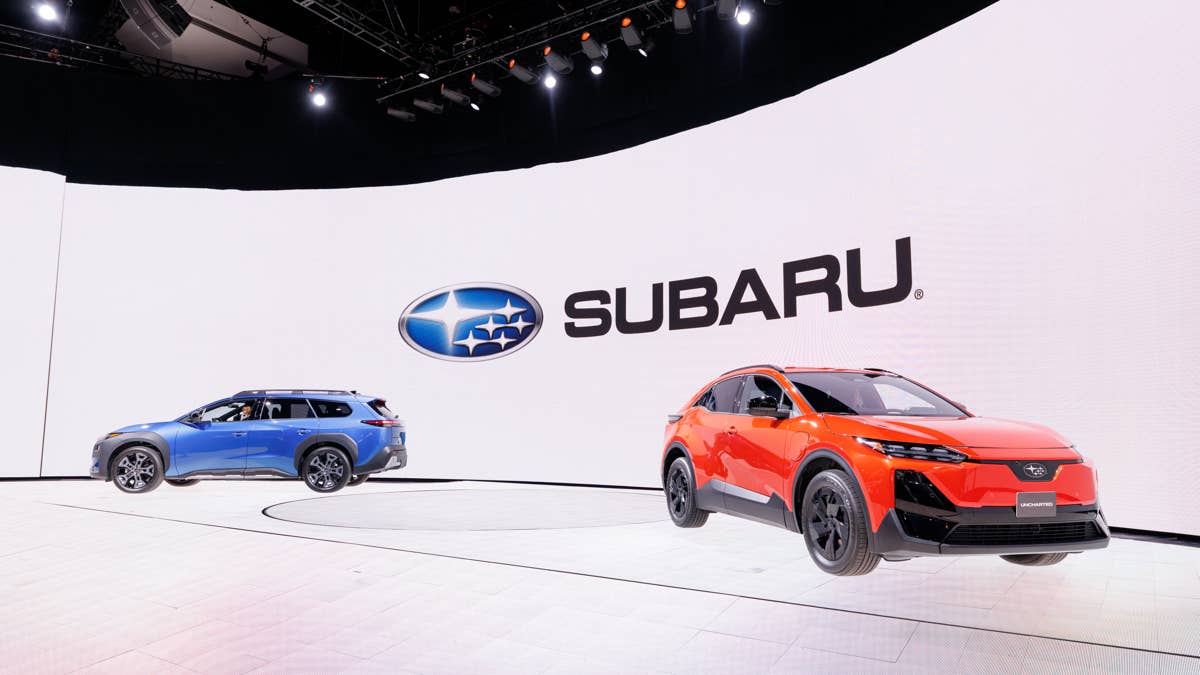
Subaru will have four EVs available to U.S. consumers by early next year while continuing to invest in gas and hybrid models, and it has approved a redesign of the Ascent three-row crossover, according to Automotive News. The Impreza survives, too, in a segment most rivals mothballed years ago.
More Automotives:
- GM displays Q2 growth in key areas Tesla would be jealous of
- Down 99%, popular EV stock is ripe bankruptcy candidate
- Elon Musk just got a new rival on three fronts
The fourth EV is the three-row Getaway, a 420-horsepower, seven-seat SUV with more than 300 miles of range and a native NACS charging port, according to Subaru of America. It is the most powerful production vehicle the company has built.
Read the strategy sideways, and it is less about electricity than about coverage. Subaru of America chief operating officer Jeff Walters described the goal as “expanding our versatile lineup of models offering gas, hybrid, and fully electric options,” the company’s year-end sales statement explained. Subaru sold 643,591 vehicles in the U.S. in 2025.
That is the whole bet. Let buyers pick the powertrain, and refuse to guess which one wins.
Why the Getaway delay complicates the story
Four days after the product plan surfaced, the company confirmed the Getaway is slipping. “The start of production for the Getaway is expected to be delayed,” Subaru said in a statement provided to Carscoops, with no revised date offered.
The Getaway shares a Kentucky assembly line and most of its hardware with the electric Toyota Highlander, which flagged its own eight-week slip early in July.
Related: Top Toyota exec urges Japan’s automakers to unite
My read is that this makes Subaru’s position more interesting, not less. A company panicking would have used the Toyota delay as cover to quietly shelve the model. Subaru confirmed a schedule change and kept the vehicle.
The broader market may be turning toward that patience. U.S. EV sales rose 14.2% from the first quarter to the second, and Cox Automotive said the market “now appears to be stabilizing after the anticipated correction,” reported InsideEVs.
What Subaru’s bet means for your next car payment
Strip out the strategy talk, and this lands on a practical question. When you finance a vehicle for 72 months, you are betting the manufacturer still cares about that product line in 2032.
Buyers who purchased a canceled model this cycle are finding out what the other answer feels like. Software updates thin out. Dealer expertise drifts elsewhere. Resale takes the hit that shows up on the trade-in sheet, not in a press release.
Subaru’s calculation is that keeping the Impreza, redesigning the Ascent and shipping four EVs costs less than guessing wrong. It is an expensive way to stay flexible, and it is the reason a Subaru shopper in 2028 will probably still have a choice.
Watch the third-quarter EV numbers and the Getaway production date. If both hold, the brand that refused to fold will have bought something the write-down crowd cannot get back quickly, which is a lineup already in showrooms when demand returns.