






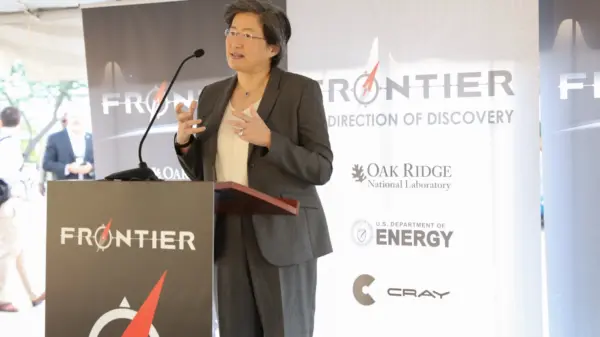





The lazy reading of Tuesday’s Advanced Micro Devices tape is that Lisa Su promised more chips and the stock went up. She promised a larger 2027 supply and, in the same Taipei scrum, said demand is still ahead of what AMD can ship. Reuters, datelined Taipei on 6 October 2026, quoted her saying the company would substantially increase supply in 2027 and that very high demand means it needs more advanced wafer capacity, with planning now three to five years out. Quartz, carried the same day on Yahoo Finance, kept a longer supply sentence: AMD can definitely use more. The session was not a one-way gap. Nasdaq shows the shares opened at $648.04, fell to $628.00, under Monday’s $631.75 close, and finished Tuesday, 6 October 2026, at $649.42, up $17.67, or 2.80%, on 24,245,860 shares. Yahoo Finance later showed the same close, up 2.80%, at 4:00:01 p.m. EDT.
Key facts
- Tuesday 6 October 2026 regular-session close $649.42, up $17.67, or 2.80%, from Monday 5 October’s $631.75. Open $648.04, high $658.52, low $628.00, volume 24,245,860. Source: Nasdaq historical prices, downloaded 7 October 2026. Yahoo Finance’s quote line shows the same close and the same 2.80%.
- Monday volume was 13,717,510, so Tuesday was about 76.8% heavier. Friday 2 October closed at $633.91 after an intraday high of $645.46. Tuesday’s close and Tuesday’s $658.52 high are the highest close and the highest intraday high in that Nasdaq file from 1 October 2025 through 6 October 2026.
- From the 31 December 2025 close of $214.16, Tuesday’s $649.42 is up 203.2%. From the 1 October 2025 close of $164.01 it is up 296.0%.
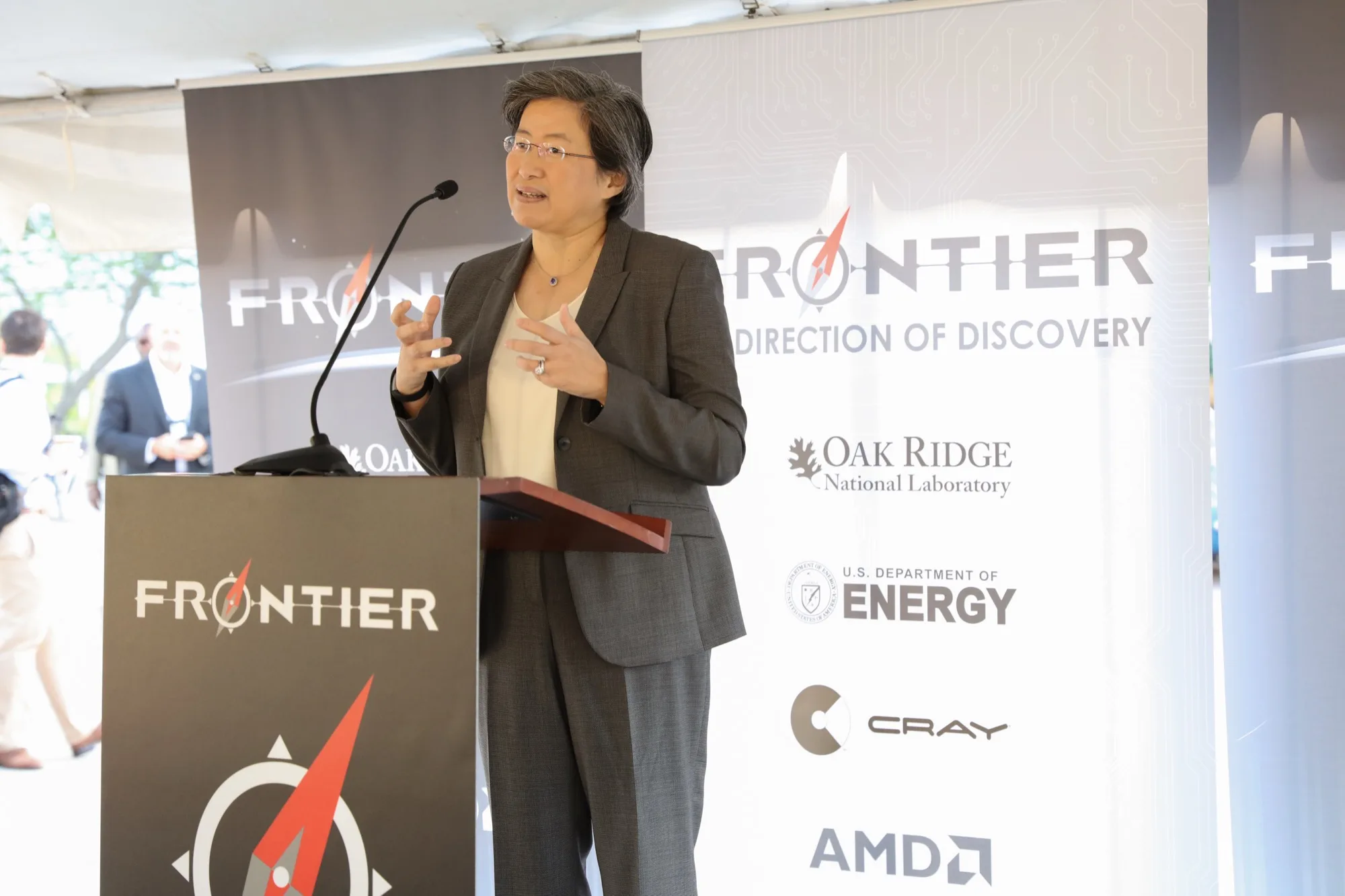
- “We’ve been able to increase our supply as we’ve gone through 2026, and we’re going to substantially increase our supply in 2027,” Lisa Su, AMD chair and chief executive, told reporters in Taipei. Source: the Reuters copy republished 6 October by Global Banking & Finance Review. The same file quotes her on “very, very high demand” and more advanced wafer capacity.
- Quartz, on Yahoo Finance the same day, called it her third Taiwan trip of the year, listed meetings with Acer, Asus, Foxconn, Quanta and TSMC, and said a May investment of more than $10 billion would rise, with no new figure. High-bandwidth memory, it reported, remains constrained.
- Citigroup analyst Atif Malik raised his AMD target to $800 from $575 on Tuesday, Yahoo Finance executive editor Brian Sozzi reported. He wrote that the shares were up 1% premarket. The official close was up 2.80%.
- SEC submissions for CIK 0000002488, checked 7 October 2026, list no AMD 8-K on 6 October. The latest 8-K in that file is 28 September 2026. AMD’s release that day valued World Labs at about $8.2 billion in stock, with a close expected by the end of 2026.
- TrendForce, on 6 October, citing Wealth Magazine, reported rising CoWoS demand and fan-out packaging that does not replace CoWoS, on a three-to-five-year plan across wafers, packaging and substrates.
What moved, and why the obvious reading is incomplete
Tuesday’s close is a high for the Nasdaq file saved here, and it is only 2.80% above Monday. Friday 2 October had already closed at $633.91 after touching $645.46. Monday gave $2.16 back, to $631.75. The net gain on Tuesday is $17.67, smaller than the jump from Thursday’s $615.73 to Friday.
The path inside the day is the part the headline drops. The open at $648.04 was already 2.58% above Monday. The low at $628.00 was 0.59% under it. The high at $658.52 was 4.24% above it. The close sat $9.10 under the high.
Volume says the argument was live. Tuesday’s 24,245,860 shares were about 76.8% above Monday’s 13,717,510 and above Friday’s 19,865,310, and the close still sat under the day’s high.
Two catalysts landed on the same morning, and they are not the same bet. Su’s Taipei remarks, in the Reuters file, are a supply comment with a shortage attached. Malik’s $800, in Sozzi’s Tuesday note, is a demand comment about Meta’s Muse agent and a larger CPU market. Sozzi’s piece is timestamped 6 October 2026 at 11:54 UTC, before the US open, and it said the shares were up 1% premarket and looked set to open at a record. The official open was $648.04, which is 2.58% above Monday, not 1%. The premarket line and the official open had already diverged before the dip to $628.00. One sentence, or one target, does not explain a day that traded both ways.
The closes used here are Tuesday’s official Nasdaq prints, and Monday’s. Wednesday’s US session had not produced a close when this was filed. Wall St Engine’s 6 October post on X said demand was still running above supply and that AMD planned to “substantially increase” supply in 2027. That is a recap. The sentences below are the wire text.
What Su, Citigroup and the supply chain actually said
Reuters.com returned an access error. The sentences that follow are on the Global Banking & Finance Review page that labels the copy Reuters, datelined Taipei, 6 October, and credited to Wen-Yee Lee.
“We’ve been able to increase our supply as we’ve gone through 2026, and we’re going to substantially increase our supply in 2027,” Su told reporters in Taipei. “There’s very, very high demand for the next several years. We can see very high demand, and so we need more advanced wafer capacity,” she said, with the report adding that planning now runs three to five years ahead. The same file says she had met Foxconn, was due to meet TSMC, and would not answer directly on a possible TSMC investment in Texas.
Quartz’s account, bylined Cris Tolomia, is not the same paragraph. It renders the supply line as: “We’ve been able to increase our supply as we’ve gone through 2026, and we’re going to substantially increase our supply in 2027, but we can definitely use more.” That last clause is not in the Reuters paragraph read here. Quartz also has her calling demand “very, very high” for several years and saying AMD needs more advanced wafer capacity. Treat the extra clause as Quartz’s rendering, not as a second transcript. “Substantially increase” is a plan. “We can definitely use more” says the plan does not close the gap.
Quartz adds what the Reuters paragraphs do not: a third Taiwan trip this year, meetings with Acer, Asus, Foxconn and Quanta, a Hsinchu stop for TSMC, and a plan to raise the May commitment of more than $10 billion without a new figure. Memory, including high-bandwidth memory, was still constrained, South Korea was later that day, and Helios shipments had started on schedule in the third quarter.
Taiwan News, at 12:44 on 6 October, was still a preview. It put South Korea on Thursday and called this her second Taiwan trip in less than five months. Reuters put Korea later on Tuesday, and Seoul coverage places her there on Wednesday. Quartz’s “third trip” disagrees with that “second.” The count is unresolved.
Packaging is in TrendForce’s 6 October note, not in the Reuters paragraphs. Citing Liberty Times and Wealth Magazine, it reported the more-than-$10 billion Taiwan plan as on track, with the planning window now three to five years across wafers, packaging and substrates. Su was reported saying CoWoS demand is rising and that fan-out panel-level packaging is being explored, not as a CoWoS replacement. Via TechNews, the same piece has TSMC’s Arizona fab progressing very well. No Tuesday AMD release turned up on these wires.
Citigroup is a different speaker. “Following the release of Meta Muse and our subsequent CPU TAM raise, we are raising estimates on AMD given our belief that AMD will be the primary beneficiary of the CPU renaissance and our belief that Meta is one of the largest customers of AMD’s server business,” Atif Malik said, as quoted by Sozzi. He added that agentic AI is, in the firm’s view, “a potential orders-of-magnitude driver of compute demand relative to traditional chatbots,” and that the firm expects the CPU market to expand from $29 billion in 2025 to $300 billion in 2030, a 60% compound rate, with AMD the key beneficiary and Intel secondary. The target went to $800 from $575. That is Malik’s number, not a FinanceFeeds target. Against Tuesday’s $649.42 it is $150.58 higher, or 23.2%. Sozzi’s headline said another 25%. The arithmetic on the official close is 23.2%.
Sozzi also wrote that AMD has projected second-half 2026 server CPU revenue up 80% and 70% in 2027, with data center revenue more than doubling in 2027 and AI GPU revenue up well over 100%. He placed second-quarter revenue at $11.5 billion and Data Center revenue at $6.7 billion. That is his account of company figures, not a 10-Q re-read here, and it does not say wafers, CoWoS or HBM are free.
The tape and the filings
The rows are the Nasdaq daily file saved for this article. Change is versus the prior close in that file. Nothing here is a Wednesday print.
| Session | Close | Change | Volume | Session range |
|---|---|---|---|---|
| Tue 6 Oct 2026 | $649.42 | +$17.67, +2.80% | 24,245,860 | $628.00 to $658.52 |
| Mon 5 Oct 2026 | $631.75 | -$2.16, -0.34% | 13,717,510 | $619.99 to $633.50 |
| Fri 2 Oct 2026 | $633.91 | +$18.18, +2.95% | 19,865,310 | $628.55 to $645.46 |
| Thu 1 Oct 2026 | $615.73 | +$3.97, +0.65% | 17,134,530 | $601.50 to $619.30 |
| Wed 30 Sep 2026 | $611.76 | +$4.19, +0.69% | 16,749,090 | $600.10 to $615.17 |
| Tue 29 Sep 2026 | $607.57 | -$0.30, -0.05% | 16,513,860 | $605.25 to $624.13 |
From the 8 September close of $505.74, twenty sessions earlier, Tuesday was up 28.4%. The 2 October high of $645.46 did not hold as the top. Tuesday’s $658.52 replaced it. The level that failed for part of the day was Monday’s close: $628.00 is under $631.75.
Filings did not move with the tape. SEC submissions for CIK 0000002488, checked 7 October, show no AMD 8-K on 5, 6 or 7 October. The latest in that download is 28 September 2026, accession 0000002488-26-000182. That day’s release is World Labs, about $8.2 billion in stock, expected to close by the end of 2026. “Building the compute platforms for the next generation of AI requires a deep understanding of how models are evolving,” Su said then. Fei-Fei Li is to join as executive vice president and chief scientist. The deal was already public. It does not add wafer starts.
FinanceFeeds’ AMD stock prediction used Monday’s $631.75 close. Tuesday is $17.67 above that spot. This article does not replace that URL and does not set a new bull, base or bear. The same Tuesday session is already covered in separate pieces on Marvell’s investor day and Ciena’s AI networking tape. Those are not this story. Su’s wafer comment sits next to FinanceFeeds’ report on TSMC’s September revenue. She did not, in the Tuesday wires read here, attach a new wafer-start number to it.
The constraint under the headline: wafers, packaging and HBM
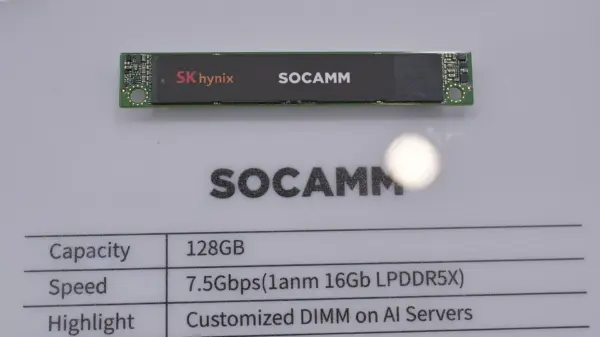
“More supply in 2027” is not a unit guide on these pages. Reuters has the wafer sentence. TrendForce puts packaging and substrates on the same three-to-five-year clock and has CoWoS demand still rising. Quartz has high-bandwidth and conventional memory tight enough that she was flying on to Samsung and SK hynix.
If Quartz’s “use more” clause is right, 2027 is not a December-quarter unit guide. TrendForce, citing Economic Daily News, said MI450 entered TSMC production in the third quarter on 2-nanometer and CoWoS, with higher-volume shipments in 2027. Quartz said Helios shipments had already begun on schedule in the third quarter. Those rungs can differ. No Tuesday AMD document found here picks one with a unit count.
Reuters and Quartz, writing Tuesday, said South Korea was later that day. Seoul Economic Daily’s Wednesday 7 October English reports of what she said after she arrived are translated from Korean, and the paper warns the wording may not match the original, so they are paraphrased here.
As reported by Kim Chang-young in the Taipei recap, timestamped 7 October at 14:28 Korea time, Su told reporters in Taipei on 6 October that supply had increased this year, demand still exceeds it, and a substantial 2027 increase would still leave a gap. The same report has her pointing to rising CoWoS demand and to other packaging, including fan-out panel-level packaging. It says she would expand the May Taiwan figure because demand keeps rising, and that she again declined a direct answer on a TSMC project in Texas.
Those Seoul remarks are later than Tuesday’s US close. Cash trading ends at 4:00 p.m. Eastern, 5:00 a.m. Wednesday in Seoul. Seo Jong-gap’s Gamer Day report, published 7 October at 16:44 Korea time, says she spoke at Dragon City in Yongsan. As reported there, she put partner relationships on a three-to-five-year clock, said she had met SK hynix chief executive Kwak Noh-jung, and was due to meet Samsung Device Solutions vice chairman Jun Young-hyun. The paper reported memory still tight, credit to both firms for MI455 and Helios, HBM use since 2015, and an intention to invest tens of billions of dollars across memory, wafers, packaging and systems. She would not discuss the meetings in detail.
None of that Seoul color was on the US cash tape Tuesday, so it cannot explain the $649.42 close. Tuesday, on the documents, is the Taipei shortage comment plus Malik’s target. His $300 billion CPU market in 2030 is a demand sketch. Her remarks say wafers, packaging and memory still have to pass that demand through. Reuters said the market value had recently topped $1 trillion. This piece does not recompute Tuesday’s equity value. The share count was not re-read from a filing here.
What happens next
Wednesday, 7 October 2026, is the first US cash session that can price the Seoul remarks, which were published after Tuesday’s close. If Tuesday’s bid was only “substantially increase,” Wednesday does not need a second leg. If the bid was the constraint, the new fact is a three-to-five-year clock on Samsung and SK hynix with memory still tight. A Wednesday trade that loses $628.00 would rhyme with Tuesday. A session that never revisits that low would say the dip held.
The fourth quarter of 2026 is the Helios test, and the sources do not agree on the rung. Quartz said third-quarter shipments were on schedule. TrendForce, citing Economic Daily News, put higher-volume MI450 shipments in 2027. Seoul Economic Daily’s Taipei recap put Helios volume in the fourth quarter. Until AMD attaches a unit or a revenue figure, both readings are schedules. The numeric checkpoint Sozzi relayed is server CPU revenue up 80% in the second half of 2026 and 70% in 2027.
Through 2027, wafer capacity, CoWoS and the other packaging TrendForce said she would keep, and HBM from the Korean meetings, have to show up in shipments before the supply sentence becomes revenue. If they do not, customers set the ceiling, and Malik’s $800 stays a CPU-market view. World Labs, about $8.2 billion and aimed at a close by the end of 2026, adds a model team, not a CoWoS slot. On the 7 October SEC check, Tuesday produced no 8-K.
Frequently asked questions
What did AMD stock do on Tuesday 6 October 2026?
Advanced Micro Devices closed at $649.42, up $17.67, or 2.80%, from Monday’s $631.75, on Nasdaq’s official print. The range was $628.00 to $658.52 and volume was 24,245,860 shares, about 76.8% above Monday. Yahoo Finance showed the same close and the same 2.80% at 4:00:01 p.m. EDT. The close is the high of the daily file saved here back to 1 October 2025.
Did Lisa Su say AMD would catch up with AI demand in 2027?
No. In the Reuters copy from Taipei she said AMD had increased supply through 2026 and would substantially increase it in 2027, and that very high demand means the company needs more advanced wafer capacity. Quartz’s same-day account adds that AMD can definitely use more supply than that increase. The promise and the shortage were in the same conversation. One without the other is the lazy reading.
What did she say about packaging and HBM?
The Reuters paragraphs read here name wafer capacity and a trip on to memory makers, not a packaging technology. TrendForce, citing Wealth Magazine, reported that she tied rising AI shipments to CoWoS demand and to other packaging, including fan-out panel-level packaging, which it said was not a CoWoS replacement. Quartz reported her saying high-bandwidth memory and conventional memory are both constrained. Exact packaging wording was not in the Reuters text opened for this piece.
Why was Tuesday not a straight rally on the headline?
The open was $648.04, already 2.58% above Monday, then the shares traded to $628.00, under Monday’s close, before finishing at $649.42. Sozzi’s premarket note had them up about 1% before the open. The official open and the official low both disagree with a story in which the headline was bought and never sold. Volume was the heaviest of the last three sessions.
Do the Seoul comments explain Tuesday’s close?
They do not. Seoul Economic Daily’s English reports of her Gamer Day remarks were published on Wednesday 7 October, Korea time, after the Tuesday US cash close. They can matter for Wednesday’s US session. Tuesday’s close was already on the tape. The paper also warns that its English is a translation and may not match her original wording, so those remarks are paraphrased here.
Does this article set a new AMD price target?
It does not. Citigroup’s Atif Malik has a published target of $800, raised from $575 on Tuesday, which is 23.2% above the $649.42 close. That is his figure. FinanceFeeds’ separate prediction used Monday’s $631.75 close and stays at its own URL. This note does not add a bull or a bear price. It is not financial advice.