






















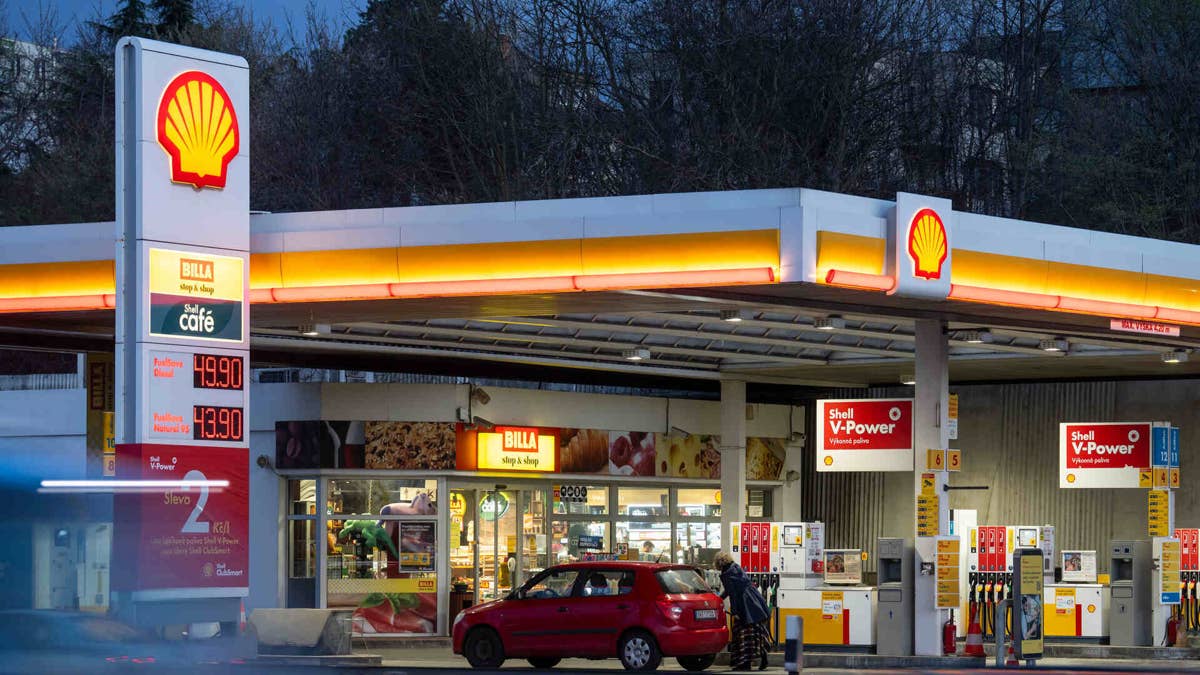
There is a specific sequence in energy markets that anyone who follows oil prices knows, and Shell CEO Wael Sawan just described it in plain language on CNBC’s Squawk On The Street.
First, the raw crude price spikes. Then the refineries pivot to produce whatever product commands the highest price. Right now, that is jet fuel, which tripled in price after Middle Eastern exports were cut off.
But maximizing jet fuel means cutting back on something else. And that something else is diesel and gasoline.
Today, what you’re seeing is all the price signals that we are short on diesel and gasoline.
Sawan continued on CNBC. “Which means we need to be able to now reoptimize at the refining side.”
For American drivers and businesses that depend on diesel, that message carries a practical implication because the fuel squeeze is not over. It is just shifting to a different product category.
Shell (SHEL) is up 24.86% year-to-date and 31.05% over the past year, according to Yahoo Finance. The company reported its best quarterly profit in four years on July 30, according to a CNBC report, with Q2 2026 revenue surging 45% to $94.7 billion.
Also Read: Shell PLC Latest News and Stories
What Shell CEO said about the diesel and gasoline shortage, and why it matters
The mechanism Sawan described to CNBC is worth understanding in detail.
When the Iran war disrupted Middle Eastern jet fuel exports, aviation fuel prices spiked. Refineries globally, including Shell’s, responded rationally to market signals. They maximized production of the highest-priced product.
Shell increased its jet fuel production by approximately 20% in response to that price signal, according to Sawan‘s remarks.
That 20% jet fuel addition came at a direct cost. Refinery units running at maximum throughput allocate barrel inputs across competing product streams. More jet fuel output means less diesel and gasoline from the same barrel of crude.
As the jet fuel shortage eased and aviation activity normalized, the diesel and gasoline deficit that accumulated during the pivot is now showing up in product-market signals.
Related: Shell CEO sends blunt message on oil and the economy
“The price signals are that we are short on diesel and gasoline,” Sawan said. Remember, that is a CEO with real-time visibility into global product markets telling investors and viewers that the next leg of fuel-cost pressure may arrive at the pump, not the aircraft gate.
Shell’s Q2 fiscal 2026 global indicative refining margin surged to $24 per barrel, up from $17 per barrel in Q1, according to the company’s earnings release.
Shell’s refineries ran at a record 102% utilization rate in Q2, up from 99% in Q1. That utilization level is not sustainable indefinitely. Q3 guidance projects utilization easing to 93%-101% due to planned maintenance.
Shell’s record quarter and the numbers behind the ‘best profit in four years’ headline
The Q2 2026 results, reported July 30, were genuinely historic across multiple metrics, according to Shell’s earnings release.
- Revenue of $94.7 billion was up 45% from $65.4 billion in Q2 2025
- Income attributable to shareholders reached $10.8 billion, up 196% from $3.6 billion in the same period last year
- The Products segment, covering refining and trading, delivered $2.5 billion in adjusted earnings for the quarter
- Chemical margins hit $270 per tonne, up from $139 per tonne in Q1
- Realized oil prices averaged $89 per barrel compared to $72 in Q1
Shell also announced a $3 billion share buyback program consistent with its 40% to 50% of cash flow from operations (CFFO) distribution policy.
“Record performances in every part of our business,” was how Sawan framed it on CNBC.
“Whether it was upstream, whether it was our refining business, which was running at utilization rates of over 100%, or our integrated gas business. Every part of the organization did well.”
The trading business as Shell’s competitive differentiator
The part of Sawan’s CNBC appearance that I found most analytically interesting was his description of how Shell navigates volatility structurally, not just opportunistically.
“Our world-leading trading and supply business could take those molecules and optimize them by selling them into the market at the appropriate prices,” said Sawan.
He described traders sitting side by side with asset managers in the refining business, working simultaneously on sourcing feedstock and managing product output.
This integrated model allowed Shell to run refineries above 100% capacity while simultaneously rebalancing its product mix toward jet fuel when that price signal was strongest, and now preparing to pivot back toward diesel and gasoline as those shortfalls emerge.
It is a competitive advantage that smaller refiners with more rigid production profiles cannot replicate.
More Shell PLC
- What Memorial Day weekend gas prices mean for start of summer travel
- Scott Bessent sends strong message on Iran finance to G7
- GasBuddy signals gas-price reset amid shift in Iran War
The ARC Resources acquisition in Canada, expected to close in Q3 2026, expands Shell’s North American natural gas and liquids supply, adding feedstock optionality that further insulates the integrated model.
Marketing sales volumes dipped slightly to 2,570 thousand barrels per day in Q2 from 2,627 in Q1, with mobility fuel stations at 1,867 thousand barrels per day. Q3 marketing volumes are forecast between 2,550 and 2,750 thousand barrels per day, suggesting stable retail demand even as product-mix pressures escalate.
For investors, the diesel and gasoline shortage Sawan described is not a distant risk. In fact, it is an active market condition. And Shell, with its trading-integrated refining model, is positioned to capture value from exactly this kind of product dislocation.