























Micron Technologies (MU) CEO Sanjay Mehrotra has already given investors plenty to think about in 2026. Now he’s asking investors to look beyond the current memory boom, backing a sprawling $10 billion investment to push the envelope on technologies that go well beyond anything on its existing roadmap.
Micron’s arguably been the pick of the AI trades this year, with the memory-chip maker’s stock more than tripling this year, putting it in rarified air even after a choppy summer.
Despite weakness of late, Seeking Alpha data show Micron stock has risen 33% over the past three months and 128% over the past six.
Also read: History of Micron: The story behind the computer memory giant
Its illustrious run has everything to do with surging demand for high-bandwidth memory and growing confidence that the relentless AI spending isn’t slowing anytime soon.
Now Micron’s putting a massive number behind that optimism, unveiling plans to invest $10 billion over the next decade in Micron Research Labs.
Speaking with CNBC’s veteran analyst Jim Cramer from Micron’s headquarters, Mehrotra linked that enormous $10 billion commitment to a far bigger claim about where memory now sits within the AI boom and why its old role may no longer fit.
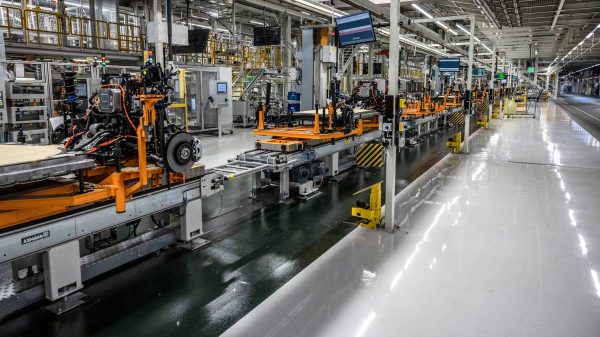
Ting Shen/Bloomberg via Getty Images
Why Micron is looking past today’s memory cycle
Mehrotra’s broader message to investors is that Micron isn’t treating memory as essentially a supporting act in the AI buildout.
“Memory is strategic infrastructure of AI,” the Micron CEO told Cramer, arguing that smarter, quicker AI entails a ton of high-performance, lower-power memory.
According to him, memory is “no longer a commodity”, and without it, AI cannot scale. That said, the sheer scale and scope of Micron’s latest commitment lend it greater weight.
More Micron:
- Michael Burry increases his bet against popular chip giant
- Bank of America doubles down on Micron stock after AI bombshell
- Micron stock jumps as investors look beyond GPUs in AI chip trade
Micron is planning to invest $10 billion over the next decade in Micron Research Labs, which is a long-horizon research institution headquartered in Boise.
Interestingly, the work will stretch beyond today’s product roadmaps into critical memory technologies, advanced memory, compute architectures, packaging, and future chip manufacturing.
Additionally, Micron is planning university collaborations, global satellite labs, and major ecosystem partnerships, with a flagship Boise facility likely to break ground in 2027 and host hundreds of researchers.
With a 10-year horizon. Mehrotra described the strategy as “looking around the corner” to the memory and compute systems future AI will need.
For investors, that’s a clear message that Micron’s looking to be proactive in influencing what comes beyond the current HBM cycle.
Over the long-term, that might position the company further upstream in the AI stack, while giving it earlier exposure to emerging technologies and tighter links with customers, universities, and chip-industry partners.
Naturally, that payoff is far from guaranteed or immediate at this point, but Micron is spending heavily today to redefine what AI hardware will need next.
Why Micron can’t afford to fall behind
Micron’s $10 billion research push also has a defensive angle, given that its biggest memory rivals are generating a ton of cash and aren’t standing still.
SK Hynix remains the company Micron needs to chase in HBM.
According to Counterpoint Research data, SK Hynix accounted for 58% of HBM sales in Q1, while Micron and Samsung each accounted for 21%.
Naturally, that lead translates into massive earnings power. SK Hynix reported Q2 sales of 79.3 trillion won and operating profit of 60.5 trillion won, up 257% and 557% from a year earlier.
At the same time, SK Hynix is reinvesting aggressively. Reuters reported that the company is looking to raise 2026 capital spending to the high-40-trillion-won range, up from 30.2 trillion won last year.
On top of that, it is in talks with nearly 10 long-term customers on agreements lasting five years, giving it stronger visibility into future AI memory demand.
Moreover, Samsung might be the more immediate technological threat.
A recent TrendForce report showed that Samsung became the first supplier to complete HBM4 validation and begin shipments in Q2, while Micron remained more focused on HBM3E.
Moreover, Samsung has shipped what it calls the industry’s first HBM4E samples to major customers. Looking at the numbers, its semiconductor division generated 127.5 trillion won in Q2 sales and 89.2 trillion won in operating profit.
Also, the broader DRAM market remains tough, too. TrendForce data cited by Biggo put Samsung’s Q1 sales at 38.5%, SK Hynix’s at 28.8%, and Micron’s at 22.4%.
For Micron, that makes its enormous $10 billion commitment look less optional, as its rivals already have incredible scale, customer relationships, and enormous cash flows to fund the next generation.
Micron stock looks cheap, but there’s a catch
For Micron investors, the valuation picture seems strangely split.
The stock has already delivered tremendous gains, but earnings-based multiples suggest Wall Street expects bottom-line strength to improve much more quickly than the share price.
Seeking Alpha data shows Micron trading at 13.27 times forward non-GAAP earnings, around 42% below the sector median of 22.86.
Moreover, its forward GAAP P/E of 13.42 is even further behind the sector’s 29.77 multiple.
Those numbers make Micron look relatively cheap if today’s AI earnings surge continues to prove durable.
Related: Jim Cramer sees trouble brewing for stock market
However, other metrics convince investors not to confuse a low PE with an outright cheap stock. Micron trades at around 8.5 times forward sales, about 150% above the sector median. Moreover, its trailing price-to-cash-flow sits 27% above Micron’s historical norm.
Nevertheless, Wall Street remains bullish.
Seeking Alpha’s Wall Street consensus shows an average price target of $1,515.11, implying 55.5% upside, although the range from $361 to $2,200 underscores how widely views still differ.
The $10 billion research commitment in particular could strengthen the case long-term, but it also raises the stakes:
Micron must continue to convert today’s spending and AI demand into sustained margins. Further evidence of that, along with support from the broader market, could push the stock’s next leg higher.
More On Micron Stock: