

















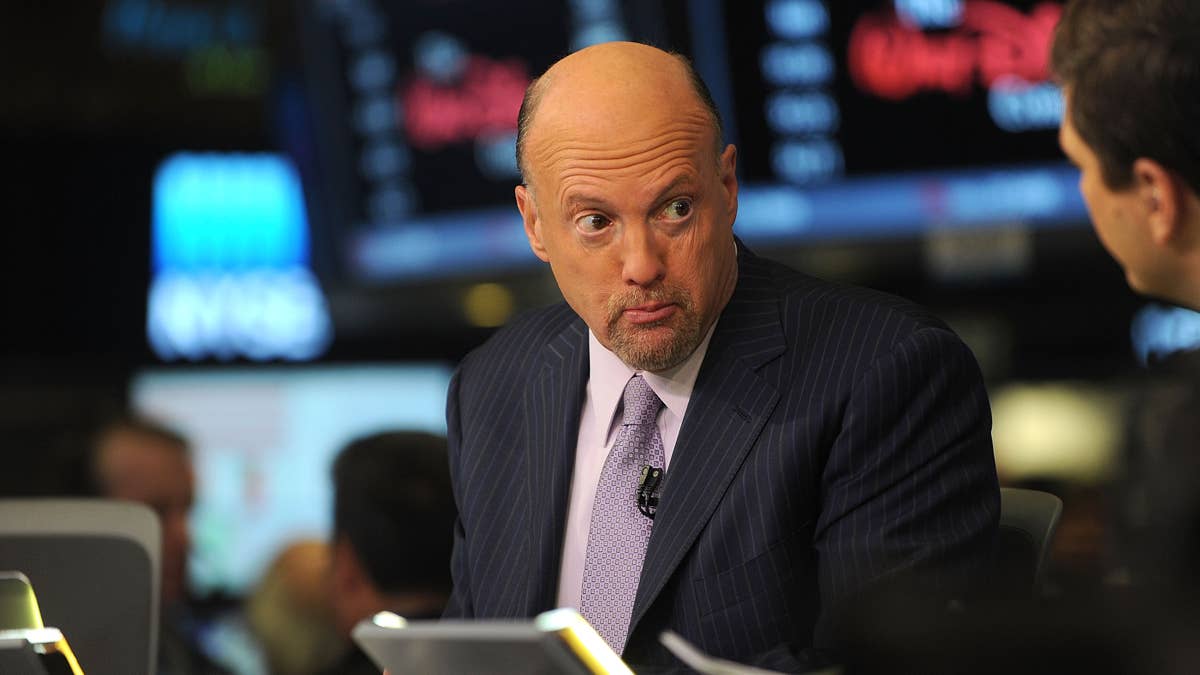
“There’s so much to dislike about the economy,” Jim Cramer said in the latest episode of “Mad Money,” ticking through tech turmoil, oil, inflation, housing affordability, and the bond market.
Investors clearly have a lot to worry about.
The S&P 500 wrapped up Aug. 18 at 7,691.76, down 0.69%, while the Nasdaq slid 1.33% to 26,289.71 and the Dow fell 116 points to 53,343.40, according to the Associated Press.
It marked a third straight drop for the index after the index hit a record just a day earlier, with chip stocks in particular taking a brutal hit.
The economic backdrop didn’t offer much comfort, either, to be fair.
July payrolls dropped by 23,000, and retail sales dropped 0.6% for their first decline in nine months, while The Wall Street Journal reported July housing starts tanked 12.4%.
But Cramer, ever the contrarian, argued investors might be focusing on the wrong side of the economy.
And his reasoning gets a lot more interesting beneath the headline figures.
Cramer says the economy looks better beneath the surface
Cramer believes Wall Street is essentially mistaking a collection of surface-level problems for an economy that’s falling apart.
He first pointed to consumer spending.
Airbnb (ABNB), he said, is “on fire,” while, according to him, Home Depot (HD) delivered its best quarter in five years, backed up by tremendous strength from professional contractors. What was mighty encouraging was that this happened even while housing itself “barely has a pulse,” Cramer said.
Airbnb stock is up 48% over the past six months, blowing past the S&P 500’s 12% gain, and more than 25% this month after reporting blowout Q2 earnings, as reported by Seeking Alpha.
The company’s Aug. 6 report showed revenue surging 17% to $3.61 billion, about $40 million higher than the $3.57 billion LSEG consensus. EPS of $1.37 topped the $1.26 estimate by 11 cents, while Airbnb raised its full-year revenue growth outlook.
More Wall Street:
- Wall Street’s AI trade faces its biggest valuation test
- The next Wall Street shift is already underway
- Wall Street sends strong 4-word verdict on the stock market
Home Depot reported earnings on Aug. 8, with sales rising 5.7% to $47.86 billion, blowing past the $47.27 billion consensus by $590 million. Adjusted EPS of $4.92 beat estimates of $4.73 by $0.19.
Hence, the sluggishness in the housing market isn’t dragging everything else down with it.
Cramer made another big claim. “At the end of the day, we’re a service economy,” he said. “If service is doing well, you can’t be too negative.”
Then he went further: “Two-thirds of our economy may be doing better.”
According to Cramer, the economy is already proving remarkably resilient, even before housing meaningfully recovers. Once the housing market improves, spending on remodeling, construction, and related services offers another leg of support.
He talked about Toll Brothers (TOL) and its superb revenue, home sales, and margins, despite elevated interest rates as another major clue.
Moreover, the stock is up around 17.5% over the past three months, according to Seeking Alpha, having again surpassed top- and bottom-line estimates in its latest quarterly showing by a healthy margin.
Oil prices are also critical to those concerns.
Related: Jim Cramer’s net worth: How much does ‘Mad Money’s' stock-picking superhost make?
Cramer acknowledged that elevated crude prices are hurting consumers, primarily through diesel, which jumped to $5 a gallon. However, he doesn’t expect the shock to continue intensifying forever.
With Brent around $91, Cramer doesn’t foresee oil prices “skyrocketing much past $100.” On top of that, he forecasted added U.S. production, including growth from New Mexico and the Bakken, to help contain prices.
For perspective, as of Aug. 19, with Brent trading around $91.47, it’s up 50.3% in 2026, Reuters reported.
That also matters for inflation.
Rising oil pushes transportation and business costs higher, driving Treasury yields up. Cramer believes that oil might eventually reach a point where it stops pushing bonds lower every day, removing a massive source of pressure on markets and the economy.
And regarding bonds, he said that although higher yields are painful, he rejects the idea that they constitute a financial crisis.
Cramer thinks Wall Street is too bearish
Cramer’s call on the economy leads directly into a far more aggressive call on the stock market.
The market’s been punishing the areas that carried it to record highs, especially semiconductor and data-center stocks.
Following the steep sell-off, Cramer notes that investors wanted little to do with that group. However, that’s exactly where he sees opportunity.
Cramer pointed to what he described as record short betting against the Nasdaq, suggesting investors might have become too negative about the situation.
“When a trade gets that crowded, is it usually wrong?” he asked. His Investing Club was already looking to scoop up beaten-down data-center stocks, including Micron (MU).
For context, Micron stock is trading at around 14-times forward non-GAAP earnings, 81% lower than its 5-year average, according to Seeking Alpha.
According to Cramer, investors are pricing in a far worse economic scenario than the one he’s seeing.
So if the economy holds up better than what’s being feared, the beaten-down stocks might have a lot more room to rebound.
If oil prices remain high but stop rising, bond yields stablize, and consumer spending holds up well, investors might not need a dramatic rebound for the beaten-down stocks to work.
Additionally, Cramer even said the higher rates might make tech companies much more cautious with spending. Yet he feels he’s “not turning tail on that group” and remains a buyer.
“At these prices,” he argued, even lukewarm optimism can create opportunity. He calls it “damning the market with faint praise” but emphasizes that it is still praise.
What Cramer’s call means for investors
Cramer’s argument essentially prompts investors to look for places where expectations may have fallen a lot faster than the underlying business scenario.
Bank of America recently identified 16 beaten-down AI-related stocks that it believes to have attractive fundamentals, despite tanking more than 20% from their highs, according to MarketWatch.
The list includes the likes of Micron, Lam Research (LRCX), Seagate (STX), CoreWeave (CRWV), and Vistra (VST), among others.
That resembles Cramer’s strategy of scooping up high quality data-center names after steep market drops.
However, the opportunity might be even broader than AI.
Morgan Stanley’s Mike Wilson argues that market leadership is broadening beyond chip stocks as earnings growth spreads a lot more toward economically sensitive businesses.
More recently, he urged investors to hunt for high-quality businesses with durable earnings and fortress-like balance sheets as the cycle matures.
For investors, that strengthens Cramer’s broader point.
If we see the economy remaining mostly resilient instead of being spectacular, the better trade might actually be selective exposure to businesses whose earnings remain robust while their stocks have absorbed a substantial dose of pessimism.
Related: SanDisk sends strong signal to Micron investors, BofA says