






















In June 2018, General Electric (GE) quietly disappeared from the Dow Jones Industrial Average, ending a 111-year run that predated the index itself, according to Bloomberg.
The removal didn’t bankrupt GE. It simply made official what investors had already priced in years earlier.
Nike just lived a version of that same story in 2026. Nike (NKE), the world’s largest sportswear company by revenue and once a fixture of nearly every large-cap fund, is losing a different kind of standing.
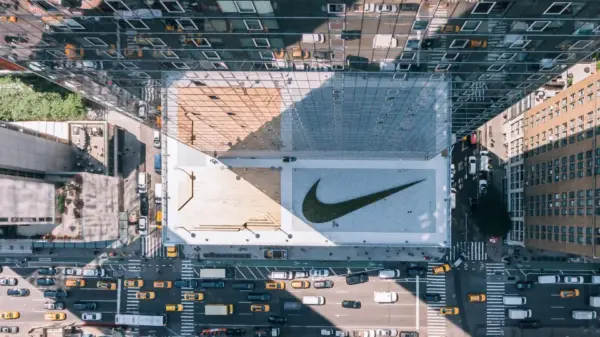
S&P Dow Jones Indices confirmed on Sept. 4 that Nike will drop out of the S&P 100 before trading opens on Sept. 21.
The company remains in the broader S&P 500, but its exit from the top-100 club is a first for a brand that once defined what a blue-chip consumer stock looked like.
Related: Popular shoe brand’s stock erased $200 billion in market value
S&P Dow Jones Indices is dropping Nike from the 100
The S&P 100 is a narrower slice of the S&P 500, built to track the 100 largest and most established U.S. companies across every sector.
Large index funds and ETFs benchmark directly to it, so membership decides which stocks those funds are required to hold. Losing a spot doesn’t delist a company, but it does shrink the pool of investors obligated to own its shares.
The rebalance is not a single swap. Four companies are leaving the S&P 100 and four are entering, and every incoming name comes from the information technology sector, according to the official announcement.
Reading the filing closely matters here. In the S&P Dow Jones Indices release, Palo Alto Networks (PANW) appears as the addition listed directly against Nike’s deletion, the same document that pairs SanDisk with Colgate-Palmolive and Arista Networks with Simon Property Group.
That pairing is not a coincidence of formatting. It is a snapshot of which businesses the market now treats as essential infrastructure.
The numbers behind the exit are hard to ignore
I wrote last month about Nike’s stock erasing roughly $200 billion in market value since its November 2021 peak.
That damage has since grown past $220 billion, according to Forbes, as shares closed at $38.40 on Sept. 4, near a 12-year low. Nike’s market value now sits around $57 billion, down from roughly $264 billion at its 2021 peak.
That number matters more once it is set against the index Nike is leaving. The S&P 100 itself climbed roughly 83% over the same five years Nike shares fell more than 75%.
The gap between those two numbers, not the removal itself, is the real story here.
Palo Alto Networks is taking Nike’s old seat
Palo Alto Networks sells cybersecurity software, much of it built around defending the AI systems companies are racing to deploy.
Chief Executive Nikesh Arora has argued publicly that rising AI investment demands an entirely new security stack, a case CNBC has covered as Wall Street’s patience with legacy brands like Nike wears thin.
For investors, the contrast is the point: one company is being paid a premium for defending digital infrastructure, while the other is being penalized for a slow-moving consumer turnaround.
Dell Technologies, Arista Networks and SanDisk round out the incoming class, and each sells equipment behind the same AI buildout.
That matters because the S&P 100 is meant to track America’s largest, most durable companies. Its committee just decided that durability looks more like data centers and network switches than sneakers and apparel.
The stock’s decline traces back to Nike Direct, the online and retail arm built to sell straight to consumers, and to Greater China, where local rivals like Anta and Li Ning have taken share for eight straight quarters, as I reported last month.
More Retail Coverage:
- Sportswear giant continues store closures nationwide
- Albertsons stock in hot water after sobering reveal
- 88-year-old retailer closing 75 stores, slows expansion
Those pressures didn’t appear overnight, and they are the real reason the index deletion arrived when it did.
Nike is not without a plan. New Chief Financial Officer David Denton, who joined Aug. 17 after leading finance at Lowe’s and Pfizer, is steering a turnaround that includes cutting off more than 1,000 third-party sellers in China, according to CNBC, to consolidate control over its own sales channels there.
The shift says more about the market than Nike
Index committees rarely cause the damage they announce. They confirm it, the way S&P Dow Jones Indices did when it pulled GE from the Dow two decades after the conglomerate’s decline had already begun.
Nike’s removal works the same way. Wall Street analysts, JPMorgan’s Matthew Boss among them, have already staked out sharply divided views on whether the stock stabilizes soon.
The more interesting question is not whether Nike claws its way back into the S&P 100. It is whether more household consumer names follow it out as index committees keep rewarding companies that sell the infrastructure behind artificial intelligence over companies that sell almost anything else.
That reshuffling has been building quietly for years, and investors watching the next rebalance in December should expect it to keep going. Nike’s swoosh once seemed permanent on that list. Nothing on an index is.
Related: Nike stock could suffer because of JPMorgan verdict