




















Tesla has had a rough year by its own standards. Profits are shrinking, cash flow has turned negative, and the stock has trailed nearly every one of its Magnificent 7 peers.
A new policy out of Washington has nothing to do with cars, robots, or chips, yet it could still hand Tesla’s energy business a real opening.
President’s power grid order could benefit Tesla energy storage
On Aug. 26, President Donald Trump declared a national emergency and signed an executive order aimed at keeping foreign-made equipment off the U.S. power grid, Utility Dive reported.
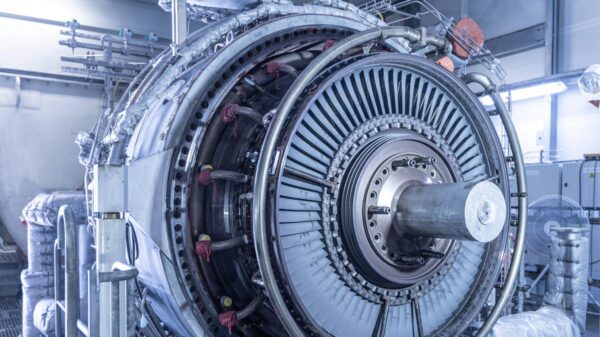
The order covers transformers, inverters, battery storage systems, circuit breakers, generators, turbines, and the software that runs them. Cybersecurity and sabotage risks were cited as the rationale.
Any transaction involving equipment from a “Covered Foreign Entity” after Aug. 26 falls under the restrictions. The Department of Energy now has up to 180 days to spell out exactly which countries, companies, and products are covered, according to the White House.
Until that rule lands, utilities are left guessing about the order’s full scope.
More Tesla:
- Tesla sales rebound hides costly problem for investors
- Tesla record revenue masks cash burn, $1B SpaceX swing
- Elon Musk, Tesla and SpaceX face serious questions from investors
The order also reaches equipment already installed across the grid. Energy Secretary Chris Wright has been directed to identify existing foreign-made equipment that poses risks. He must also recommend remedies, which could range from additional monitoring to outright removal, giving utilities an incentive to start lining up domestic alternatives now rather than later, Utility Dive reported.
China’s dominance in key underlying supply chains makes the stakes clearer. The country accounts for roughly 80% of global lithium-ion battery production capacity and 85% of solar manufacturing capacity.
This means that any serious push toward domestic sourcing could have significant implications for energy developers and the utilities powering the U.S. grid, Quartz reported.
Why Tesla’s energy business could be a winner
Tesla is one of a handful of U.S. companies with an existing, at-scale grid battery storage product, which is why analysts see it as a potential beneficiary of the policy shift. The company’s Energy Generation and Storage business has become its fastest-growing major segment, and Wall Street has increasingly built that growth into its valuation models, Fox Business reported.
RBC’s own sum-of-the-parts model for Tesla assigned 15% of the company’s valuation to Megapack energy storage, alongside 52% for Robotaxis and 27% for full self-driving software, with the traditional car business making up just 6%, TheStreet reported.
That weighting shows how far Tesla’s own investor base has already shifted away from thinking of it purely as an automaker.
Demand for that storage capacity has been climbing independent of any policy change. UBS analyst Joseph Spak projected 15.1 gigawatt-hours of energy storage deployment in the first quarter alone at the time, up 45% year over year, driven by grid upgrades and AI data center demand, even as the same analyst kept a Sell rating on the stock overall, according to TheStreet.
A separate 25-gigawatt-hour Megapack supply deal with NatPower, announced ahead of Tesla’s second-quarter earnings, further reinforced energy storage as one of the company’s more established growth engines.
Tesla’s supply chain complicates the clean domestic-winner narrative. The company has reportedly committed to sourcing at least 20 gigawatt-hours of battery cells from China’s CATL for stationary storage between 2026 and 2028, representing roughly 30% of Tesla Energy’s projected cell needs.
This shows that Tesla is not entirely insulated from the same foreign-sourcing questions the executive order is meant to address.
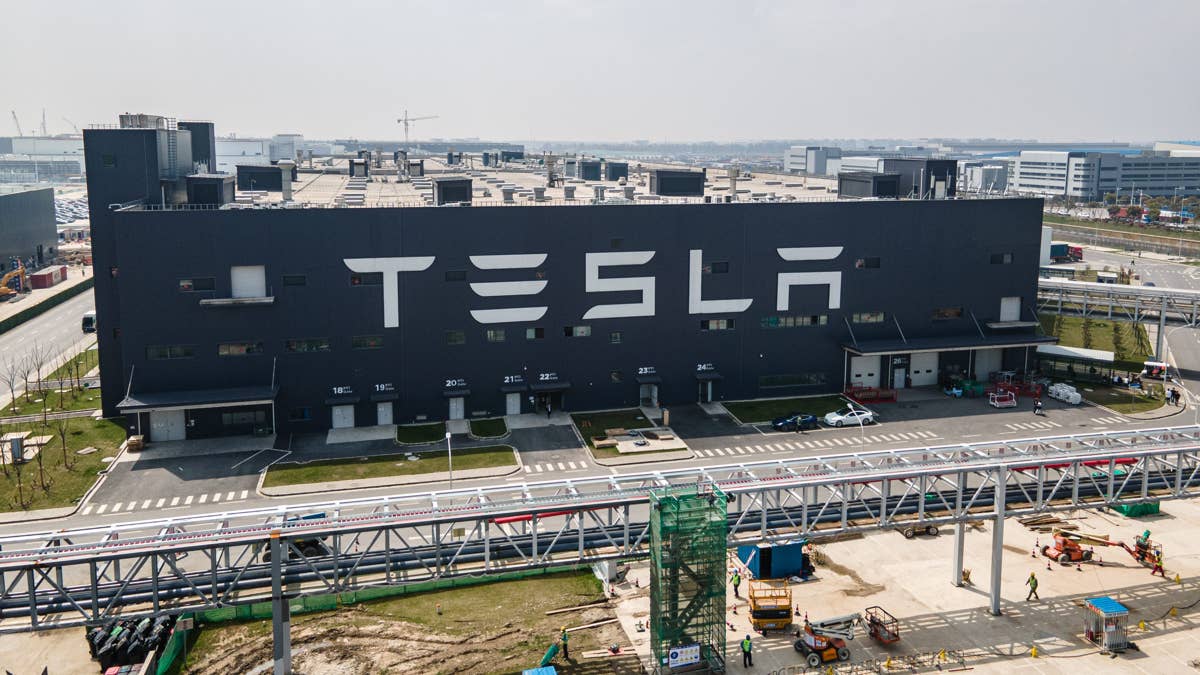
Xiaolu/Getty Images
Tesla’s stock still has a rough 2026 to explain
Tesla shares were up roughly 12% over the past 12 months but have fallen nearly 18% so far in 2026, while badly trailing the S&P 500’s roughly 12% year to date. Shares have remained roughly 26% below their all-time high of $498.83, set in December 2025, according to Barchart.
Tesla’s second-quarter 2026 earnings, released July 22, explain why. Revenue climbed 26% year over year to a record $28.24 billion, beating Wall Street estimates, yet the stock still fell roughly 5% the next session as profitability came in far weaker than expected, Barchart noted.
Free cash flow went negative $1.09 billion for the quarter. A year earlier it was positive $146 million. The first quarter of 2026 had come in at positive $1.44 billion. That reversal in three quarters, not the revenue beat, is the number that spooked investors, according to Barchart.
Some of Tesla’s reported net income also reflects unrealized SpaceX equity gains, rather than cash the business actually generated.
Capital expenditures told the same story from a different angle. Spending jumped 142% year over year to $5.79 billion, up from $2.39 billion in the prior-year quarter. This reflects the scale of Tesla’s simultaneous bets on Robotaxis, humanoid robots, and semiconductor manufacturing, Utility Dive reported.
What Tesla investors should watch next
The executive order is best treated as a potential long-term tailwind rather than an immediate catalyst. The Department of Energy’s rulemaking process will not conclude for months, and any resulting shift in utility purchasing habits toward domestic suppliers will take additional time to translate to Tesla’s actual order backlog.
The more immediate signal to track is whether Megapack deployment growth continues to outpace the rest of Tesla’s business in upcoming quarterly reports, since that is the segment most directly positioned to benefit if utilities start favoring U.S.-linked suppliers.
Investors should also watch how quickly the Department of Energy names specific covered entities, since a narrow list would blunt the policy’s practical impact on Tesla’s addressable market.
Tesla’s next earnings report, expected in October, will be the first real opportunity to see whether energy storage bookings show any measurable shift tied to the new rules, or whether the order remains mostly a headline-level opportunity layered on top of a business still working through a difficult year on the car side.
Related: Morgan Stanley sends a blunt Tesla message to investors