


Affordability keeps hitting home, and hitting hard, across the country this summer.
Inflation-weary Americans once again are looking in disbelief at rising gasoline prices and the eye-popping costs of even the cheapest cuts of beef to toss on their grills.
Meanwhile, Kevin Warsh has said very little since taking over as chairman of the Federal Reserve in May. He has, however, repeatedly vowed that the policymakers at the U.S. central bank will focus on price stability, which you and I refer to as — ahem — inflation when we’re in polite company.
It’s important to note that Warsh has not said how policymakers will do this. They meet July 28-29 to vote on interest-rate policy, and consensus indicates a nearly 65% chance they’ll hold rates steady. But there are increasing signals that a rate hike as soon as September could be in the hawkish viewpoints of Fed officials.
Goldman Sachs Chief U.S. Economist David Mericle said in an email note to TheStreet that although modest interest-rate hikes by the Federal Open Market Committee might signal the Fed’s commitment to lowering inflation, economic research shows this action rarely proves effective “mainly because businesses and consumers — unlike financial market participants — pay little attention to central banks.’’
This means the limited one or two interest-rate hikes in the short term touted by some Fed watchers and prediction markets will have very limited impact on curbing price pressures from supply shocks that are preventing the Fed from reaching its own 2% inflation target, the note said. The Fed has missed this metric for the last five years.
That message is consistent with Goldman’s estimate that the combined impact of tariffs, the Iran war, and mismeasurement of artificial intelligence accounts for most of the overshoot of 2% for core PCE and all of it for core CPI, the note said.
“There is evidence that inflation expectations affect how businesses set prices, and that in experimental settings, providing people with information about the central bank — its target, its inflation forecast, or its policy actions — influences their inflation expectations at least slightly,’’ the note added.
Warsh commits to “price stability“
“While monthly price fluctuations are inevitable — especially in an unsettled world —underlying inflation over longer time horizons is determined largely by monetary policy,’’ Warsh said in prepared remarks while delivering the Fed’s twice-yearly Monetary Policy Report to Congress July 14-15.
The report, issued July 10, said the outlook of the future path of interest rates “is subject to considerable uncertainty.” It also described the U.S. economy as overall “expanding at a solid pace despite elevated uncertainty that owes, in part, to the conflict in the Middle East.’’
Warsh repeatedly reminded members of both chambers that the Fed is committed to its dual Congressional mandate: use interest rates and balance-sheet policy to keep prices stable and the labor market at full employment.
That’s tricky.
- Lower interest rates support hiring but can fuel inflation, potentially leading to an inflationary spiral.
- Higher rates cool prices but can weaken the job market. This increases the cost of borrowing and further stifles economic activity.
As I reported, Warsh consistently repeated his pledge that the central bank would work on its “resolute commitment” to restore price stability.
Fed holds interest rates steady thus far this year
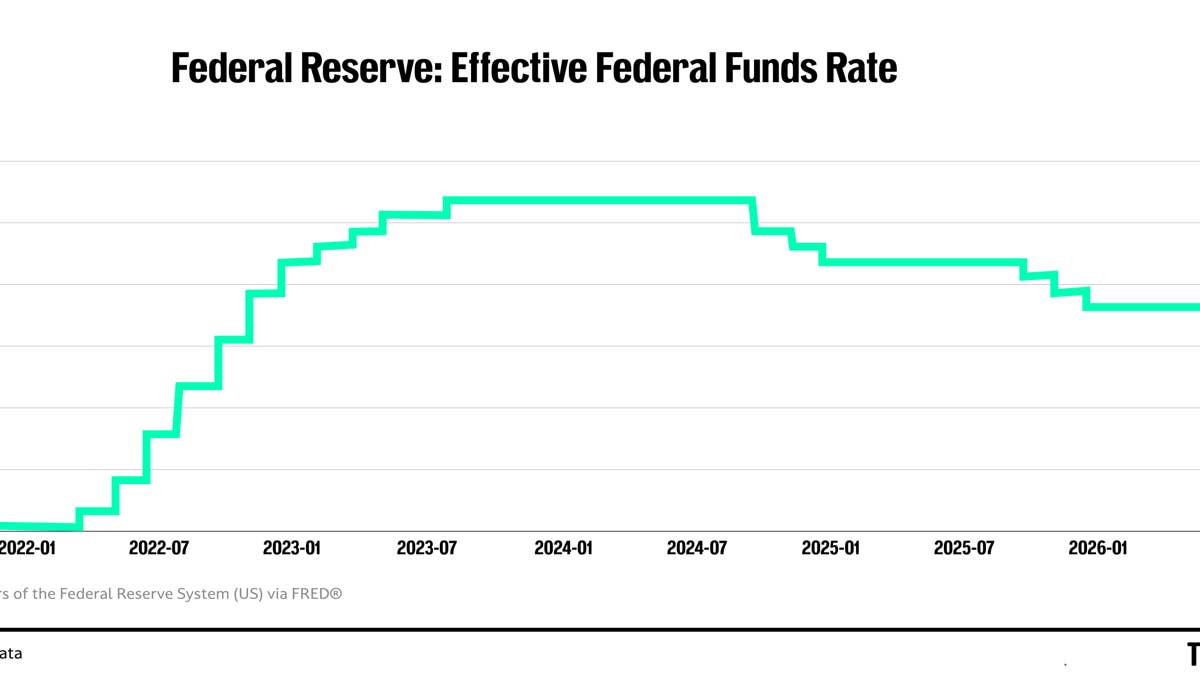
The rate-setting FOMC voted unanimously in June to hold its benchmark Federal Funds Rate target at a range of 3.5% to 3.75%.
But the minutes of the June FOMC meeting showed policymakers splitting their views on inflation risk and the impact on interest rates with a rising hawkish tinge to the “dot plot.”
How the Federal Funds Rate impacts you
The funds rate is the interest rate at which banks lend balances at the Federal Reserve to other banks overnight.
A change in the funds rate triggers moves in borrowing costs ranging from credit cards to auto loans to even mortgage terms.
Related: Warren Buffet delivers powerful 2-word judgment on Fed’s Warsh
Policymakers had cut rates by a quarter point at each of their last three meetings of 2025 to shore up the softening labor market.
These “insurance” cuts stopped after the majority of policymakers decided the risk from higher prices was outweighing signs that the jobs market was stabilizing.
Goldman cites supply shock concerns, rate path
June Headline CPI dropped to 3.4% month over month from May’s 4.2% figure. Core inflation stayed flat. The drop was attributed to the reported peace accord of the Iran war that saw the energy shock since February abate.
However, in recent weeks, both sides have escalated attacks, and crude oil prices are back on the rise.
As of July 24, the widely watched CME Group FedWatch Tool shows financial markets are pricing in higher probabilities of interest-rate hikes for the final months of this year, while expecting a 64.2% probability that rates will remain steady and a 35.8% chance of a quarter-point rate hike.
This is a marked change from the week before, which saw a near 90% chance of July rates remaining steady.
- September shift: Traders now price in a nearly 79% cumulative chance of at least one quarter-point rate hike happening by or during the September FOMC meeting.
- December tightening: By the end of the year, the CME Group FedWatch Tool leans heavily toward a half-point hike, reflecting sustained inflation concerns.
The Goldman note said that a “key lesson of recent years is that the effects of supply shocks on inflation are often large, while the effects of changes in resource utilization are moderate.
“In short, there is little reason to think that the limited hikes currently being entertained by the bond market would provide much help in bringing inflation down.
“We suspect that most FOMC participants would share this view, though some might also feel that after the pick-up in job growth in recent months, a hike or two probably would not hurt much either.’’
Related: Fed’s Warsh drops fresh clues on interest-rate path