











SpaceX stock is not expensive because the market has lost its mind about rockets. It is expensive because the market has already agreed to pay for an artificial-intelligence business that does not yet appear in the accounts — and the two contracts underpinning that business can each be cancelled on 90 days’ notice. That is the whole SPCX debate in one sentence, and it is why our 12-month range is a $215 bull case against a $90 bear case from a last close of $136.97 on 21 August 2026. SpaceX booked $7.81bn of Q2 revenue, up 92% year on year, and spent $18.37bn on capital expenditure in the same three months — 235% of revenue. Free cash flow for the first half was negative $25.0bn. Those are the numbers that decide which case wins, and neither the bulls nor the bears have to invent anything to make their argument.
Here is the part almost nobody has run the arithmetic on. Chief Financial Officer Bret Johnsen guided investors to $100bn of annualised revenue run-rate by December 2026. Working forward from the Q2 actual and adding only the incremental contracts SpaceX has actually disclosed — the Google agreement that begins in October and the $6.7bn of third-quarter cloud contracts management referenced on the call — we can build roughly $56bn of December ARR. That leaves a gap of about $44bn, and it implies December revenue running at 3.2 times the Q2 monthly rate. Be fair to the company and assume the Anthropic contract steps up from its reduced ramp fee to its full $1.25bn per month, and the build reaches roughly $64.6bn — the gap narrows to about $35bn, but it does not close. SpaceX has simply not disclosed contracts accounting for it. Part may be Cursor, whose revenue the company has never broken out. That is the single most important unanswered question in the stock, and it is answered in December, not before.
Key facts
- Last close $136.97, 1.5% above the $135.00 IPO price and 39.3% below the $225.64 intraday peak of 16 June — stockanalysis.com, 21 August 2026
- Q2 revenue $7,814m, up 92% from $4.1bn; net loss $(541)m; adjusted EBITDA $3,538m — SpaceX Q2 2026 earnings release (8-K EX-99.1), 4 August 2026
- Q2 capital expenditure $18,369m, of which $15,828m was AI infrastructure — equal to 235% of quarterly revenue — same release
- First-half free cash flow −$25.0bn ($3,466m operating cash flow less $28,476m capex) — FinanceFeeds calculation from the Q2 release
- $100.0bn cash and securities against $39.4bn of debt, of which $13.3bn is owed to Valor, an entity related to a company director, carrying $327m of interest in the quarter alone — Q2 2026 Form 10-Q, Note 17
- Two customers were 37.8% of Q2 revenue — Customer A at 18.3% and Customer B at 19.5% — 10-Q, Note 3
- Enterprise value roughly $1.80trn on $23.0bn of trailing revenue: 78x sales — FinanceFeeds calculation from SEC filings, corroborated by stockanalysis.com
What the June IPO actually priced, and what has happened since
SpaceX listed on Nasdaq in June 2026 at $135 a share. The stock closed its first session at $192.50, peaked at $225.64 intraday on 16 June, and then spent seven weeks going in one direction. By 3 August it had touched $104.83. It has since recovered to $136.97 — which means that after two months of extraordinary volatility, the market has arrived back within 1.5% of where the underwriters priced it. Anyone who bought the open and held has lost money; anyone who bought the IPO allocation is roughly flat.
The mechanical reason for the round trip is supply. Two large lock-up tranches have hit the market since the start of August: a 911.5-million-share release around 6 August — worth well over $100bn at the prices prevailing that week — and a further 319 million shares on 20 August that lifted the tradable float by roughly a fifth. We covered the first of those unlocks as it happened and the August tranche that followed. Each one produced a down day and each one was bought. That is the bull case in miniature: the float has roughly tripled and the stock is still above its IPO price.
The fundamental reason is that SpaceX is no longer principally a launch company. The AI segment consumed $15.83bn of the $18.37bn of second-quarter capital expenditure. The company is building compute, and it is financing that build with a $25bn bond issue priced in June across five tranches at a weighted average coupon of 5.855%. The launch business, meanwhile, is doing what it has always done: 78 launches in the first half, plus two Starship flights in May and July which the company describes as “deploying 20 production V3 satellites, demonstrating in-space relight of a Raptor engine, and executing the softest ever splashdown.”
What the stock is really pricing is management’s confidence about the compute business. As Musk put it on the earnings call: “To be clear, the $100 billion ARR in December is not a question mark. That’s what we’d achieve if we basically did nothing.”
What the contracts say, and what they conspicuously do not
The AI revenue is real, contracted, and disclosed — and more fragile than the headline numbers suggest. The IPO prospectus discloses that in May 2026 SpaceX signed cloud services agreements with Anthropic PBC covering approximately 325,000 NVIDIA GPUs, under which the customer “has agreed to pay us $1.25 billion per month through May 2029, with capacity ramping in May and June 2026 at a reduced fee.” A separate June filing discloses a Google agreement for approximately 110,000 GPUs at $920 million per month from October 2026 through June 2029.
Now read the termination language. On Anthropic: “After the initial three-month period, the agreements may be terminated by either party upon 90 days’ notice.” On Google: “After December 31, 2026, the agreement may be terminated by either party upon 90 days’ notice” — and if SpaceX fails to deliver the committed GPUs by 30 September 2026, Google “may immediately terminate the agreement” after a one-month grace period. Roughly $26bn a year of annualised contracted revenue sits behind two quarterly notice periods. That is not a scandal; it is standard for hyperscale compute. But it is not the same thing as a backlog, and SpaceX’s disclosed backlog is a far more modest $47.5bn.
Then there is Starmind, the orbital AI data-centre programme, which is where the reporting has been loosest. SpaceX announced it on 4 August — on its own earnings call and its own X account. NVIDIA has never announced it. No contract value, no satellite count, no term, and no SEC filing of any kind. Musk’s own description of the supply side was: “Then our understanding with NVIDIA is that we will receive a very significant percent of their GPUs next year.” An understanding is not an agreement, and it is worth writing that down before the number gets into anyone’s model. We covered the Starmind announcement when it broke.
One more thing that has gone unremarked. The IPO prospectus, dated 11 June, says SpaceX expects “to begin deploying our orbital AI compute satellites as early as 2028.” On the 4 August call, 54 days later, Musk said Starmind launches would begin “next year” — 2027. A one-year pull-forward, with no filed basis for the change.
The valuation, and a short-interest number the market has wrong
At $136.97, SpaceX carries roughly 13.57 billion shares for a market capitalisation of about $1.86trn and an enterprise value near $1.80trn. Against $23.0bn of trailing revenue that is 78 times sales. Against annualised Q2 revenue it is 57.5 times. Against the $100bn ARR management has guided to, it is 18 times — which is the entire bull case expressed as a single multiple, and it only works if December arrives as promised.
Here is a genuine data error worth correcting, because it is being quoted widely. Vendor screens currently show SPCX short interest at 34.91% of float, a number that would make this one of the most heavily shorted mega-caps in market history. It is wrong. That percentage is calculated against a stale float of 595.18 million shares — smaller than the IPO tranche alone, and long since overtaken by three lock-up expiries. Against a realistic post-unlock float of roughly 1.87 billion shares, the same 207.78 million shorted shares represent about 11.1%. Against total shares outstanding, 1.53%. Elevated, not existential. Days-to-cover sits at 2.85.
| Measure | Bull reading | Bear reading |
|---|---|---|
| Revenue growth | +92% year on year in Q2 | Off a small base, and two customers are 37.8% of it |
| Capex $18.37bn | Building an irreplaceable compute moat | 235% of revenue; H1 free cash flow −$25.0bn |
| $100bn ARR guide | 18x EV/sales if delivered | ~$44bn of it is not traceable to disclosed contracts |
| AI contracts | ~$26bn/yr contracted to December 2029 | Both cancellable on 90 days’ notice |
| Balance sheet | $100.0bn cash | $39.4bn debt, $13.3bn of it related-party |
| Float | Tripled and absorbed; stock still above IPO | A further large tranche unlocks in November |
For context on how much of the sector moves with this one name, SpaceX’s post-IPO slide dragged the entire listed space complex with it — a dynamic we traced across Rocket Lab, AST SpaceMobile and the rest of the group.
Governance, index mechanics and the disclosure gap
Three structural issues sit underneath the equity story, and none of them are priced in any obvious way.
The first is related-party financing. Of $39.4bn in total debt and finance leases, $13.3bn is owed to Valor, an entity connected to a company director, and it cost $327m in interest in the second quarter alone. This is disclosed properly in Note 17 of the 10-Q. It is not hidden. But a company with $100bn of cash choosing to carry $13.3bn of director-affiliated debt is a governance fact institutional allocators will have a view on.
The second is key-person risk, which the prospectus addresses with unusual bluntness in its risk factors: “We do not maintain key-person life insurance on Mr. Musk.” Musk holds 6,418,547,515 shares, roughly 48.4% of the company. Alphabet holds 7.2%.
The third is index mechanics, which are widely misreported. SPCX is already a Nasdaq-100 constituent, admitted under the IPO Fast Entry rule that waives the usual seasoning requirement. It is not eligible for the S&P 500, and cannot be for some time: that index requires twelve months of seasoning with no fast track, and a GAAP profitability screen that trailing losses cannot clear until roughly August 2027 at the earliest. Anyone modelling near-term S&P inclusion flows is modelling something that cannot happen this year.
There is also no Starlink spin-out. The word does not appear anywhere in the 1.54-million-character prospectus, in any form. Starlink itself now reports 12.0 million subscribers, but average revenue per user has fallen through four consecutive readings — $99, then $91, then $81, and now $66 — which is what scaling into lower-income markets looks like, and it matters more to the 2027 model than any single launch.
Evercore ISI’s Kutgun Maral put the capital-intensity question to management directly on the call, noting that to “become a true fourth U.S. carrier, would imply well over $100 billion of mobile Capex over time, much of auction spectrum and greenfield infrastructure.”
The $215 bull case and the $90 bear case
The bull case to $215 requires December ARR to arrive somewhere near the guide. At $100bn of annualised revenue, today’s enterprise value is 18 times sales — unremarkable for a business compounding at 92% with a structural monopoly in launch and a genuine position in AI compute. $215 is not an aggressive number in that world; it sits between the street’s $213.50 average and $220 median, and 5% below the stock’s own June high. The path runs through Google’s contract starting on time in October, the November unlock being absorbed as the previous three were, and a December ARR print that closes most of the gap. Note that the bull case does not require Starmind to work, or a single orbital data centre to fly.
The bear case to $90 does not require fraud or failure. It requires only that the AI revenue proves as cancellable as its contracts say it is. Strip the compute business back toward $45bn of revenue and 26 times sales gets you to roughly $90 — below the $104.83 low set on 3 August, and above the $75 that marks the low end of published street targets. The trigger set is specific: a missed 30 September GPU delivery gives Google an immediate termination right; either large customer serving 90 days’ notice removes roughly half the AI revenue within a quarter; and a December ARR print in the $60bn range would reprice the entire multiple. All of that lands while free cash flow runs at roughly minus $25bn per half and a further tranche of about 1.3 billion shares unlocks in November.
The honest position between those two is that the market is currently pricing neither. At $136.97 the stock sits almost exactly on its IPO price, which is what a market looks like when it genuinely does not know. The street ranges from $450 to $75 across 35 analysts with a median of $220 — a spread of six times between the highest and lowest published target on a $1.86trn company. That spread is the story. It will narrow in December, and not before.
Musk himself, in an SEC-filed interview transcript published on 8 June, framed the roadmap with more caution than his critics generally allow: “People should take this with a grain of salt to some degree because this is just our best guess. So, this is not a promise of what we’ll do. This is what we are going to try to do and think we probably can do…” That is the right posture for anyone underwriting this stock at either end of the range. Our own read: the reclaim of the $135 IPO price was a genuine signal of demand, but it settles nothing until the December number lands.
Frequently asked questions
What is the SpaceX (SPCX) share price today?
SPCX closed at $136.97 on 21 August 2026, 1.5% above its $135.00 June IPO price and 39.3% below the $225.64 intraday peak set on 16 June. The stock has traded between $104.83 and $225.64 since listing, making it one of the most volatile mega-capitalisations on Nasdaq.
What is a realistic SpaceX price prediction for the next 12 months?
Our range is $215 on the bull case and $90 on the bear case. The bull case assumes December annualised revenue arrives near management’s $100bn guide, putting the shares on 18 times sales. The bear case assumes the AI compute contracts, both cancellable on 90 days’ notice, do not hold at current scale.
Is SpaceX profitable?
Not on a GAAP basis. SpaceX reported a net loss of $541m in the second quarter of 2026 on revenue of $7.81bn, alongside adjusted EBITDA of $3,538m. First-half free cash flow was approximately negative $25.0bn, driven by $28.5bn of capital expenditure, most of it on AI infrastructure rather than launch.
When does the next SpaceX lock-up expire?
A further tranche of roughly 1.3 billion shares is scheduled to unlock in November 2026. Two earlier tranches cleared in August — a 911.5-million-share release around 6 August, worth over $100bn at the time, and a 319-million-share release on 20 August — each of which produced a single down session that was subsequently bought.
Will SpaceX join the S&P 500?
Not in 2026. SPCX is already a Nasdaq-100 constituent via the IPO Fast Entry rule, but S&P 500 eligibility requires twelve months of seasoning with no fast-track equivalent, plus a GAAP profitability test that trailing losses cannot satisfy until roughly August 2027 at the earliest.
Is Starlink being spun out as a separate listing?
There is no disclosed plan. The words spin-off, spinoff, carve-out and separate listing do not appear anywhere in SpaceX’s 1.54-million-character IPO prospectus. Starlink reported 12.0 million subscribers, with average revenue per user declining across four readings from $99 to $66 as the service scales into lower-income markets.
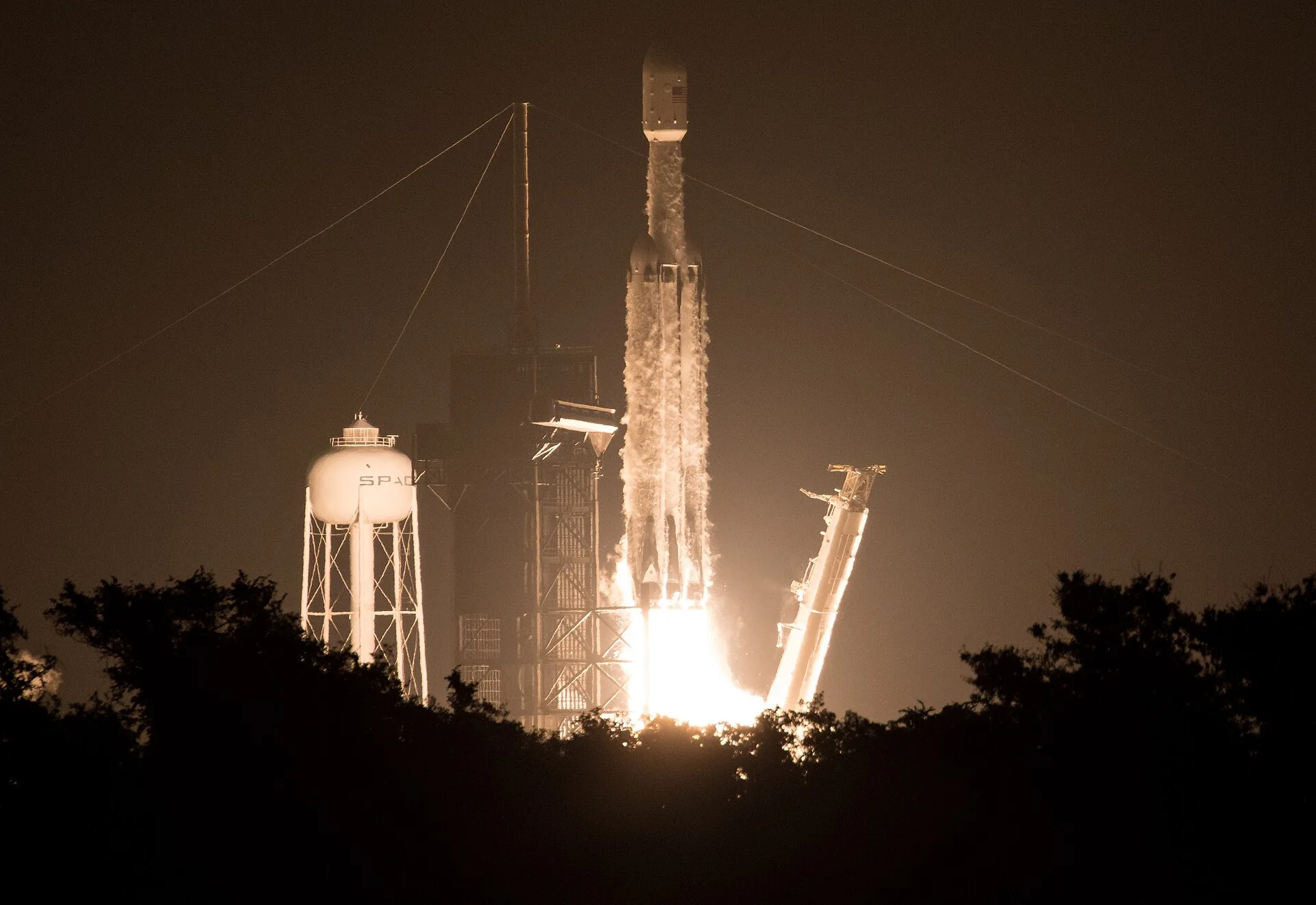
This article is editorial analysis and is not investment advice. Figures are drawn from SpaceX’s SEC filings and its Q2 2026 earnings call transcript; market data from stockanalysis.com as of 21 August 2026. Price targets are FinanceFeeds estimates and may not be achieved. Featured image: NASA/Joel Kowsky, public domain.