











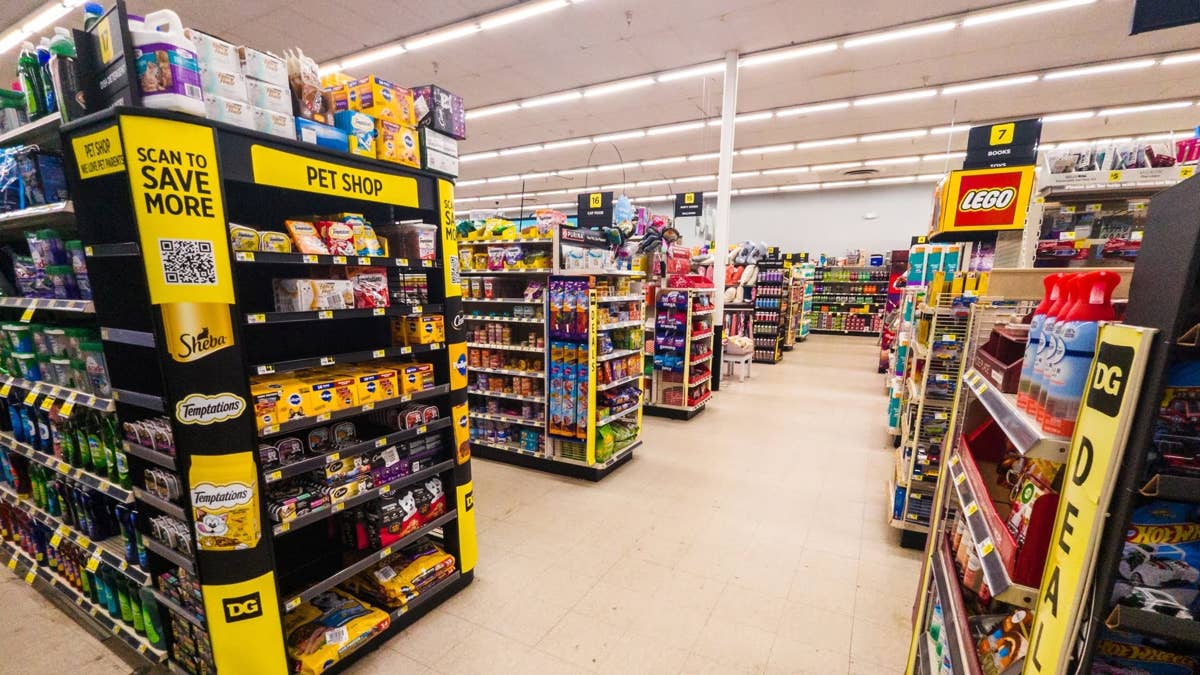
The economy has changed Dollar General’ customer base.
“We are seeing customer penetration growth across low, middle and high-income segments as customers across all income cohorts seek value at increasing rates,” said CEO Todd Vasos during the chain’s first-quarter earnings call.
It’s a shift where wealthier customers have sought out the discount chain, which has traditionally served a financially strained customer base that lives close to its more than 20,000 U.S. locations.
“Notably, across these cohorts, the largest increase in customer count came from the highest income segment, which earns more than $100,000 annually,” he added.
To better serve all its customers, Dollar General has been leaning into a strategy made famous by Costco. No, the chain hasn’t started charging for memberships. It has, however, bet big on its private-label program.
Dollar General adds more $1 items
Dollar General isn’t a dollar store, despite its name. In recent quarters, however, the chain has added more $1 price points in a section of the store it calls “Value Valley.”
“And then lastly, and I can’t emphasize this enough, that $1 price point has turned out to be a real savior for our core customer and is really resonating with the trade-in customer. We’re seeing that accelerate at a great rate, 18.4% comp in Value Valley,” Vasos said.
More Retail:
- Coca-Cola quietly hints at reinventing previously failed flavor
- Bath & Body Works quietly gains a competitive advantage
- Dollar General brings back old prices
He also noted that Dollar General now has more than 2,000 items across the store, at or below the $1 price point.
“As part of our overall approach to this price point, we continue to emphasize and strengthen our Value Valley offering, which is comprised of more than 500 rotating items, all at $1. Of note, this offering once again outperformed the chain average in Q1 with a comp sales increase of 18.4%, driven by broad-based performance across many sections and exceptional performance in health and beauty,” he added.
Shutterstock
Dollar General expands its private-label offering
While Costco has led the way with its Kirkland Signature brand, many other retailers, including Target and Walmart, have deep private-label strategies.
That’s something the majority of consumers value.
In the United States, private-label sales reached $330 billion, capturing a 24% unit share and a 23% dollar share of the total market, Circana reported in March.
“Store brands influence where people grocery shop. 56% of shoppers say their primary store’s private brand selection is very or extremely important to their decision to shop there,” according to The Food Industry Association’s (FMI) annual “Power of Private Brands 2026: Consumer Trends – From Stores to Homes.”
Now, Dollar General has expanded its efforts in that area.
“Beyond our Value Valley program, we also introduced several new $1 private label items during the quarter as well as a new frozen section, which now features a full door dedicated to new frozen items at the $1 price point,” Vasos said.
Not all of the company’s private-label products cost $1, but Vasos talked about the importance of that price point.
“Keep in mind that there’s a lot of other areas, especially in our private brand areas that come with a $1 price point that’s very meaningful for our customer as well,” he added.
Attracting higher-income shoppers is only part of the challenge. Keeping them coming back requires giving them products they trust, which helps explain why Dollar General is investing more heavily in its own brands alongside its expanding lineup of $1 items.
Related: Pepsi and Coke bet big on soda Americans say they want
Private labels have come a long way
Supermarkets carried private labels in the 1990s, but my experience with them was that they were more about value than quality. My local Star Market, for example, carried a Lucky Charms knockoff featuring a wizard, and the cereal was sold in plastic bags rather than a cardboard box.
Stores still carried white-label beer cans and other generics.
CNN explained the operating environment for house brands in the 1990s.
“Most customers were fiercely loyal to specific brands, not retailers. A store that didn’t carry major labels would likely get crushed, which gave manufacturers immense leverage,” CNN reported. “Additionally, many store brands were also considered dull, cheap knockoffs of national brands.”
Costco helped change this by building Kirkland’s reputation as a high-quality brand.
“Kirkland is a brand in its own right,” said Barclay’s Retail Analyst Karen Short, as Keith Swiednicki International noted. “It is one of the reasons people go to Costco. That’s not necessarily something you can say about many private labels.”
The concept has resonated with Americans.
“Nine in 10 American households (92%) currently have store brand products at home, up from 89% last year,” according to the FMI report.
That’s not simply about value; it’s also about the quality of the private-label brands.
“Consumers aren’t just choosing store brands out of habit or necessity; they’re choosing them because they’ve earned the trust of American families,” said Tom Cosgrove, director of industry relations for FMI.
Related: Sneaker brand closed 140 stores, and it still isn’t working