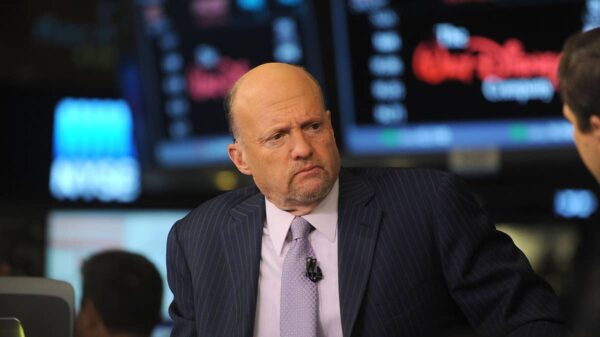





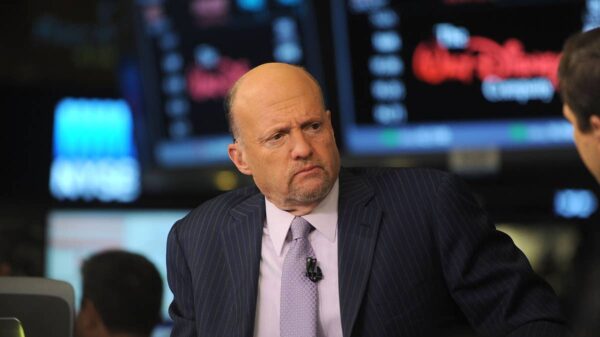






A post from Jim Cramer on X turned a routine trading day into a talking point across financial media.
The comment came at a moment when investors badly needed reassurance about the AI trade, and Cramer offered an unexpected stock.
Rather than pointing to Nvidia or another obvious AI bellwether everyone already watches closely, Cramer zeroed in on Oracle, a company whose shares had actually struggled for most of the year.
His reasoning for why that specific stock mattered says as much about the current mood on Wall Street as it does about Oracle’s own fundamentals.
Jim Cramer’s read on Oracle’s strength
Cramer posted his comment close to midday on September 17, just as Oracle shares were climbing toward what would become a 5% gain for the session. “Strength in Oracle is a very positive sign,” he wrote.
The timing mattered. Dario Amodei had just published his AI slowdown essay. Chip stocks were falling. The whole AI complex was under pressure and investors were looking for something to hold onto.
More Jim Cramer:
- Jim Cramer has terrifying one-word message for tech stock investors
- Jim Cramer says he’s steering clear of one popular stock
- Jim Cramer reveals 4 surging chip stocks he likes best
Cramer had already previewed his thinking two days earlier. In his September 15 morning appearance, he argued that even if some companies pulled back on buying AI infrastructure from providers like Dell, other buyers would simply step in to fill the gap, treating overall demand as more durable than any single customer’s caution.
What Cramer meant by pointing to Oracle specifically was that the stock’s movement functioned as a read on broader sentiment toward the AI buildout, according to 24/7 Wall St.
Oracle has become closely tied to AI and cloud infrastructure spending, and its ability to hold up under pressure offered a market-based indication of whether that spending remained intact amid headline-driven jitters.
The numbers behind Oracle’s AI bet
Oracle’s importance to that broader signal comes from just how much the company has staked on the AI buildout. Free cash flow came in at negative $5.4 billion in its fiscal first quarter, a sharp deterioration from negative $362 million in the year-ago period, while capital expenditures reached $28.5 billion for the quarter, up from $8.5 billion a year earlier, according to CNBC.
Borrowing costs climbed alongside that spending. Oracle incurred $1.4 billion in interest expenses during the quarter, up 55% from $923 million a year earlier, with interest expense now consuming 8% of revenue compared to 6% in the prior-year period.
Despite those pressures, Oracle’s backlog kept expanding at a pace that has repeatedly stunned analysts. Remaining performance obligations grew to $664 billion in the quarter, up $209 billion from a year earlier, while Oracle booked more than $30 billion of that total from new AI contracts signed during the period.
The underlying growth numbers backed up Cramer’s optimism. Oracle’s revenue grew 30% to $19.3 billion, GAAP net income jumped 60% to $4.7 billion, Oracle Cloud Infrastructure revenue jumped 121% year over year to $7.4 billion and total cloud revenue rose 62% to $11.6 billion, with the company guiding for 34% revenue growth in fiscal 2027, according to TheStreet.
Wall Street’s split verdict on Oracle
Not every analyst shares Cramer’s confidence in the spending pace. CLSA initiated coverage with a Hold rating and one of the Street’s lowest price targets, arguing that the cost of building Oracle’s AI infrastructure now outpaces the balance sheet supporting it.
Michael Burry has also maintained a bearish position in Oracle, including put options tied to the same debt concerns, TheStreet reported.
Bank of America sees it differently. The firm reinstated coverage with a Buy and a price target implying roughly 30% upside. Its read is that Oracle is one of the companies that actually wins the AI infrastructure race, debt and all, TheStreet reported.
The big funds have not left. Hedge fund ownership ticked up to 119 in the second quarter from 115 in the first. The stock is down more than 20% year to date. The funds are still holding. That says something about what they think the backlog is worth.
The forward P/E is 18.55. Price-to-sales is 6.16. Short interest is 2.6% of float. CoreWeave’s short interest is 17.84%. On all three measures, the market is not positioned against Oracle the way it is against some of its AI infrastructure peers, according to Insider Monkey.
What Cramer’s comment really signals
Cramer’s post worked as a kind of shorthand for a more complicated argument playing out across the AI trade this month. If a company as exposed to AI infrastructure spending as Oracle can hold up through safety-driven headlines, that resilience says something meaningful about how confident investors remain in the durability of underlying demand.
Oracle fell 1.9% on September 18, the day after Cramer’s post. One good session does not settle the debate. The debt is real. The execution risk is real. Cramer’s read and the bear case can both be correct at the same time, according to Insider Monkey.
The test Cramer is pointing to is simple. Oracle keeps signing AI contracts. The backlog keeps growing. If that continues, the slowdown rhetoric is noise. If it stops, the bear case gets a lot louder than it already is.
Related: After $664 billion backlog, Oracle sends shocking message to staff