























I rarely keep much money in my checking account. Most of it is spread across several investments, where I can actually see my money grow. But I still keep some cash in the bank for everyday expenses. That money may earn little or no interest.
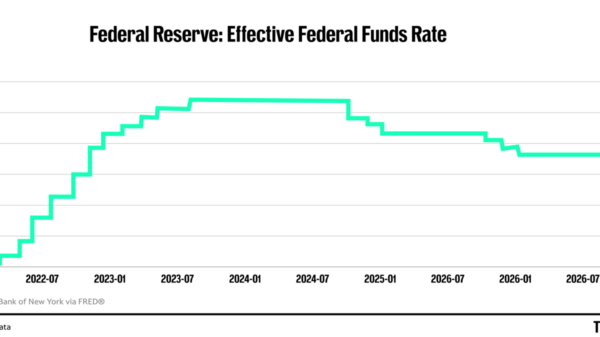
What interests me is that while my money sits there earning next to nothing, the bank can put those deposits to work. That relationship becomes even more interesting when interest rates start moving, especially for a bank like Wells Fargo as it tries to strengthen its earnings.
The bank’s scale showed up in the third quarter, reported Oct. 13, 2026. Wells Fargo (WFC) earned $5.95 billion and diluted EPS of $1.87, two cents above the $1.85 consensus, on revenue of $21.87 billion, slightly short of the roughly $22.15 billion to $22.31 billion Wall Street expected.
Our third quarter results reflect broad-based growth, higher earnings, and stronger returns.
Scharf added that average loans and deposits both increased 11% from a year earlier, while the bank continued to attract new primary checking customers, according to its third-quarter report.
Wells Fargo also repurchased $2.5 billion of stock and raised its quarterly dividend to $0.50 a share. However, one slow-moving number is still holding back the bank’s earnings engine.
Also Read: 174-year-old bank closing more branches
Wells Fargo’s small miss hides a deposit question
Morgan Stanley shared its take in a note shared with me at TheStreet on Oct. 14. Morgan Stanley said, “Modest Miss Does Not Change the ROTCE Improvement Story.”
The firm kept an Overweight rating and Top Pick status, trimming its price target to $101 from $102, based on 12.5x 2027 earnings. Morgan Stanley sees the stock as undervalued at about 1.6x 2027 tangible book value and not priced for returns rising to 17%-18%.
The shares haven’t felt that optimism yet. Wells Fargo is down 10.79% year-to-date on a total return basis, according to Yahoo Finance, though it is up only 0.36% over one year and 113.64% over three.
Related: Wells Fargo’s new S&P 500 call signals trouble ahead
The miss itself was small. Net interest income, the profit from lending money above what the bank pays for deposits, came in about 1% short of consensus. But the margin on those loans held steady at 2.43%. Credit stayed clean, with provisions of $1.03 billion and net charge-offs of $983 million, both below expectations.
Wells Fargo also reported broad-based revenue growth, with Wealth and Investment Management up 12%, Commercial Banking up 6%, Consumer Banking up 5%, and Corporate and Investment Banking up 3%.
Why cheap deposits matter to Wells Fargo’s profit
Here is the catch. Wells Fargo wants more noninterest-bearing deposits, the checking balances that cost the bank little or nothing. Average balances fell about $3 billion, or 0.9%, in the quarter. Morgan Stanley said it would have liked stronger growth, and it models just 2% average growth in 2027. It calls that growth critical to its 7% NII forecast.
I can see why attracting those deposits isn’t easy. I like having money readily available in my checking account, but leaving too much there feels like a missed opportunity when my investments offer better returns. Convenience matters, but so does making my money work harder.
More Wall Street:
- Nvidia and Micron are about to lord their successes all over Wall Street
- Nvidia, Palantir, and Alphabet send waves through Wall Street
- Wall Street elites will pocket windfall from record $46 billion profits
Morgan Stanley says lower-cost balances should follow consumer account growth and the buildout of treasury management and payments, which take time. Interest-bearing deposit costs rose 6 basis points to 2.05%.
But core interest-bearing deposits grew about $22 billion, more than funding the quarter’s asset growth. Corporate deposits, a proxy for pricier non-core funding, fell about $15 billion to $95 billion, according to the note.
That is why the fourth-quarter guidance matters. Wells Fargo guided to about $13 billion in net interest income, 1.4% above consensus, with the core banking book doing more of the work as fixed-rate assets reprice and loans grow. Annualized, the guide implies about $52 billion, roughly 4% above the $50 billion full-year guide.
Fixed-income financing balances grew 18% from the prior quarter on a gross basis. Morgan Stanley sees room for more balance-sheet netting, which lifts margin optically but can raise return on assets as clients do more on the same balance sheet.
Morgan Stanley sees a path to 17% to 18% returns
Morgan Stanley models NII growth of about 7% in 2027, with the net interest margin expanding to 2.48% by the fourth quarter of 2027. It trimmed 2027 and 2028 EPS by 1% and 2% to $8.07 and $9.58, on mostly lower buyback assumptions, while raising 2026 to $7.20. It now sees buybacks of $12.6 billion in 2026 and $15.0 billion in 2027, still 15%-20% above the Street.
Capital remains at 10.0% despite a 38-basis-point hit from higher rates. That hit also mechanically lifts return on tangible common equity, or ROTCE, by about 100 basis points in the fourth quarter. Morgan Stanley models 17.1% in 2027 and 18.4% in 2028, but says its thesis rests on earnings growth from NII, fees, card seasoning and efficiencies.
Its bull case is $124, on faster capital markets growth and loan expansion. The bear case is $63 in a mild recession with aggressive Fed cuts.
For investors, the verdict is that a modest miss doesn’t change the story, so long as deposits cooperate. Lower funding costs and steady loan growth could help Wells Fargo deliver those returns.
More Stocks News