























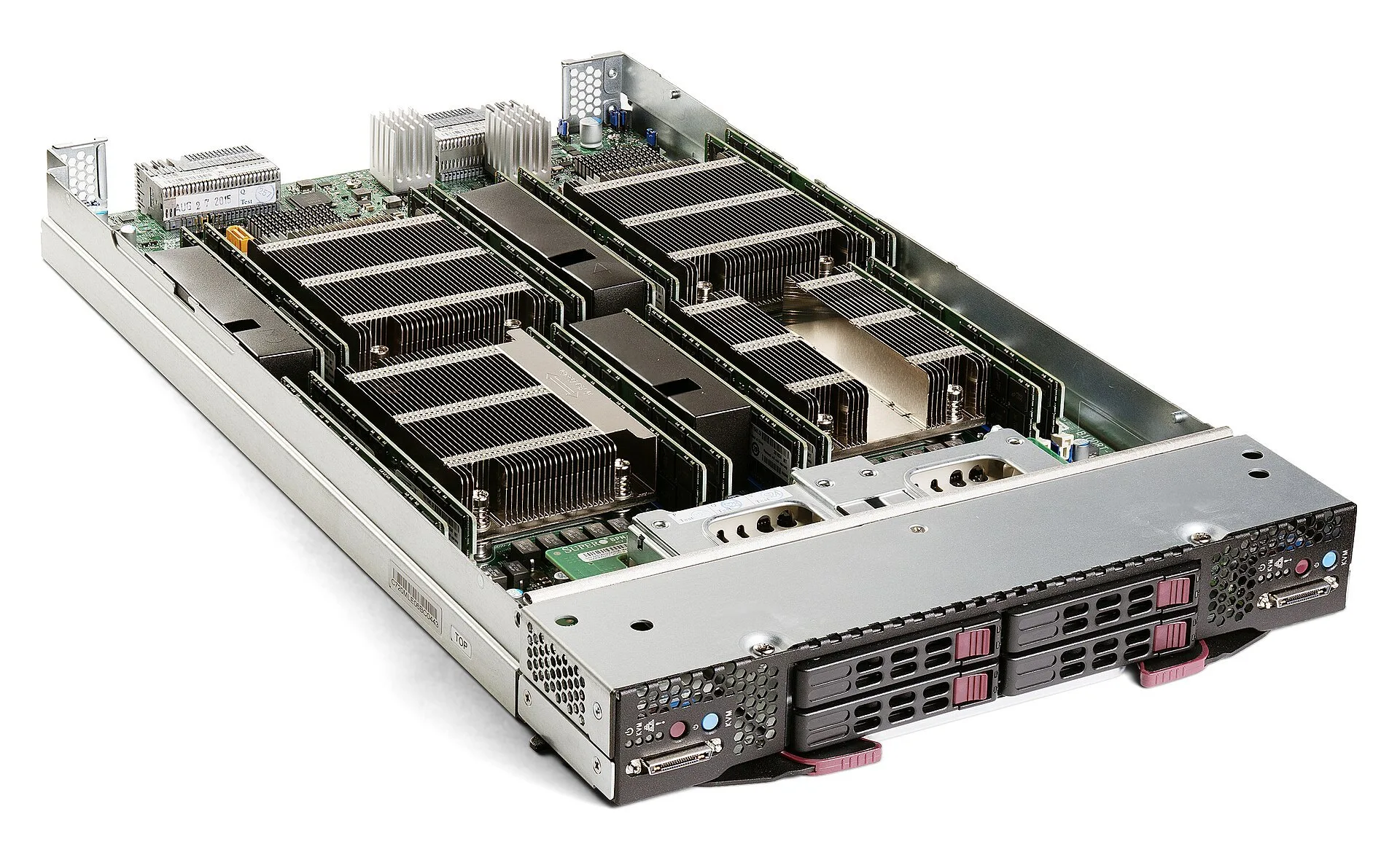
Super Micro Computer is not a margin recovery story yet, whatever the last earnings print looked like. The market read the 11 August report as a turnaround — a 17.5% gross margin against 9.9% three months earlier — and bid the stock up. But the same filing shows something the celebration skipped: Supermicro’s full-year gross margin for fiscal 2026 was 10.8%, down from 11.1% in fiscal 2025. Revenue grew 78%. Margin went backwards. One quarter does not undo that.
Here is the number nobody is quoting. Stack the four fiscal 2026 quarters of operating cash flow — minus $918m, minus $24m, minus $6,615m, plus $747m — and Supermicro consumed $6.81bn of cash in the year it booked $2.2bn of net income. That is a $9.0bn gap between accounting profit and cash generation, and it is the single most important fact about SMCI at $36.50. The company did not fund fiscal 2026 out of earnings. It funded it out of the balance sheet and, in June, out of shareholders. Any price target that ignores that gap is a target on the income statement, not on the business.
Our base case: a $64 bull case against a $19 bear case, with the stock at $36.50 as of the 20 August close. The spread is wide because the two outcomes are genuinely far apart — this is a company whose fortunes turn on a single line item it has never controlled for long.
Key facts
- SMCI closed at $36.50 on 20 August 2026, inside a 52-week range of $19.48 to $58.78 — stockanalysis.com, 20 Aug 2026
- Q4 FY2026 revenue was $11.1bn at a 17.5% gross margin, versus $10.2bn and 9.9% in Q3 — Super Micro 8-K, 11 Aug 2026
- Full-year FY2026 gross margin was 10.8%, down from 11.1% in FY2025, on revenue of $39.1bn versus $22.0bn — Super Micro 8-K, 11 Aug 2026
- FY2026 operating cash flow was negative $6.81bn against positive $2.2bn of net income — quarterly filings via S&P Global Market Intelligence
- FY2027 revenue guidance is $65.0bn to $72.0bn, against roughly $52.5bn of prior consensus — Super Micro 8-K, 11 Aug 2026
- Cash was $7.5bn against $8.7bn of bank debt and convertible notes at 30 June 2026 — Super Micro 8-K, 11 Aug 2026
- 19 analysts polled by S&P Global rate the stock Hold, average target $42.38, low $15, high $60 — S&P Global via stockanalysis.com, 20 Aug 2026
What actually happened in the fourth quarter
Supermicro reported unaudited results for the year ended 30 June 2026 on 11 August. Revenue of $11.1bn was up from $5.8bn in the year-ago quarter. Net income was $1,178m against $195m. Diluted earnings were $1.62 a share against $0.31. On a non-GAAP basis the company earned $1.70 with a 17.6% gross margin.
The gross margin is the whole story. Supermicro assembles servers around other companies’ silicon, principally Nvidia’s, and the economics of that position are brutal: the component maker captures the value and the integrator captures the volume. For six straight quarters the margin sat between 6.3% and 10%. Then it printed 17.5%.
Management’s explanation is mix. “Our Total AI/IT Solutions strategy continues to deliver strong results, we added several hundred enterprise and other customers in the past year, generated more than $60 billion in new orders, and booked record backlog entering fiscal 2027,” said Charles Liang, Founder, President and CEO of Supermicro, in the results release. The argument is that enterprise buyers, who take Supermicro’s Data Center Building Block Solutions rather than bare racks, pay more than hyperscalers do.
That argument is coherent. Enterprise mix genuinely carries better economics than selling at volume to a handful of cloud buyers, and it is the same lever that separates a systems business from a contract assembler. The question is whether one quarter of it constitutes a trend, and the full-year number says be careful: for fiscal 2026 as a whole, the mix shift was worth nothing. Margin fell.
The cash flow hole nobody is discussing
Set the income statement aside and look at cash. In the March 2026 quarter, Supermicro’s operations consumed $6.62bn. That is not a rounding error on a company with a $27bn market capitalisation — it is roughly a quarter of the entire equity value, gone out the door in ninety days.
The mechanism is inventory and receivables. To ship $12.7bn of servers in a December quarter, you must first buy $12bn of GPUs, memory and power components, and you pay for them before your customer pays you. Growth of this speed is a working-capital machine that runs in reverse: the faster it goes, the more cash it eats. This is why the December 2025 quarter — the largest revenue quarter in Supermicro’s history at $12.68bn — was also its worst gross margin quarter on record at 6.30%. The company bought volume with price.
June’s financing was the consequence. On 15 June 2026 Supermicro closed an offering of depositary shares representing 7.00% Series A Mandatory Convertible Preferred Stock, now trading on Nasdaq under the ticker SMCIP, alongside a common stock offering and an at-the-market equity distribution agreement with J.P. Morgan, Goldman Sachs and Citigroup, per the company’s 8-K filed that day. It also amended its credit agreement with JPMorgan.
Read the instrument carefully, because the word that matters is mandatory. This is not preferred stock that might convert if the share price cooperates. It converts. The dilution is not a risk to be priced — it is a scheduled event, and it is why Supermicro guided first-quarter fiscal 2027 earnings on a 745m diluted GAAP share count when the company earned fiscal 2026’s $3.26 on roughly 675m. Roughly a tenth of the equity has been handed over, and the 7% coupon is paid in the meantime.
What the guidance actually implies
Supermicro guided fiscal 2027 revenue to $65bn–$72bn. Consensus stood near $52.5bn. That is the largest single guidance beat the company has ever issued, and it is what moved the stock.
“The number that sent the stock price soaring was the fiscal year 2027 outlook where the company reported expectations of sales in the range of 65 to 72 billion,” noted Parkev Tatevosian, CFA, in a 15 August analysis of the print. He is right about the cause. The question is what the guidance costs to deliver.
Work it through. First-quarter guidance is $14.5bn–$15.5bn, roughly 22% of the full-year midpoint of $68.5bn. To reach the midpoint, the remaining three quarters must average $17.8bn — meaning Supermicro is guiding to a business that exits fiscal 2027 running at well over $70bn annualised, from $39.1bn last year. On the working-capital arithmetic above, a ramp of that shape implies another multi-billion-dollar cash absorption before the revenue converts. The $7.5bn cash pile and the amended credit line are not spare capacity; they are the fuel for the guidance.
This is the tension the market has not resolved, and it explains why a company guiding to 75% revenue growth trades at 8 to 9 times forward earnings. At $36.50 on 745m diluted shares, Supermicro is a $27.2bn company. Net of the $1.2bn debt-over-cash position, enterprise value is about $28.4bn — or 0.39 to 0.44 times fiscal 2027 sales. The market is not disputing that the revenue arrives. It is disputing what the revenue is worth.
Where the competition sits
Supermicro’s problem is that its advantage is speed, and speed is copyable. Dell and Hewlett Packard Enterprise both now ship liquid-cooled Nvidia racks, and both have enterprise sales organisations and balance sheets Supermicro cannot match. The differentiator that carried the company through 2024 — being first to market with a new Nvidia platform — compresses each cycle.
The component side is where the margin actually goes. Memory pricing has been inflating across the server bill of materials, a squeeze that has already shown up in Qualcomm’s profit outlook and that runs straight through Supermicro’s cost line. When DRAM and NAND prices rise, an integrator with a 10% gross margin absorbs it or loses the deal. Compare that with the suppliers: Micron and Western Digital are on the receiving end of the same inflation, and AMD sells silicon rather than sheet metal. Supermicro sits at the thinnest point of the chain.
There is also a governance discount that has not fully cleared. This is a company that lost its auditor, filed late, and saw a co-founder arrested in an alleged AI chip smuggling case. The fiscal 2026 figures discussed here are, by the company’s own description, unaudited — the 10-K had not been filed as of 21 August 2026. A 17.5% margin in an unaudited quarter from an issuer with this history is a number the market is entitled to wait on.
The bull case: $64
The bull case requires three things to be true at once, and none of them is unreasonable.
First, revenue lands at the top of guidance — $72bn — because the $60bn order book Liang referenced converts on schedule. Second, gross margin settles around 11.5%: not the 17.5% of the fourth quarter, but permanently above the 8% to 10% band of the last two years, on the enterprise mix shift management describes. Third, operating expense scales to roughly $3.5bn, which is disciplined but consistent with the company’s history of thin overheads.
That combination produces roughly $8.3bn of gross profit, about $4.8bn pre-tax, and near $3.8bn of net income after a 20% tax rate — call it $5.05 per share on 761m fully diluted shares. Put a 12.7 times multiple on it, still a discount to every component supplier in the chain, and the stock is $64. That is above the $60 street high and about 9% above the 52-week high, which is the correct place for a bull case to sit: reachable, not free.
The bear case: $19
The bear case does not require a disaster. It requires the fourth-quarter margin to have been what the previous six quarters suggest it was — an outlier.
Assume revenue of $58bn: a large miss against guidance, but still 48% growth. Assume gross margin reverts to 8.5%, in line with the December and September 2025 quarters. Hold opex at $3.3bn. That yields about $1.6bn pre-tax, $1.3bn of net income, and roughly $1.71 per share. At 11 times — the multiple a low-margin assembler with a working-capital problem and an unaudited balance sheet earns — the stock is $19.
Note what that price is: essentially the 52-week low of $19.48. The market has already visited this valuation once in the last twelve months, in March 2026, without any of the accounting questions being newly raised. Our bear case is also less severe than the street’s, where the lowest of the 19 targets is $15.
What we are watching
Three things decide which case wins, in this order.
The 10-K. Every figure above is unaudited. The filing of a clean, on-time annual report with the 17.5% margin intact would retire a meaningful part of the discount by itself. A delay would do the opposite, faster than any operational news.
First-quarter operating cash flow, due November. Not revenue, not EPS — cash. The fourth quarter’s positive $747m is one quarter of evidence against eight. If Supermicro can grow toward $17bn a quarter while keeping operating cash flow near breakeven, the bull case is intact and the multiple is genuinely wrong. If the ramp reopens a multi-billion-dollar hole, expect another financing, and price the dilution before it is announced.
The second-quarter margin. Guidance implies the enterprise mix holds. December is seasonally Supermicro’s largest and historically its worst-margin quarter — last December it printed 6.30% on record revenue. A December quarter above 13% would confirm the mix shift is structural. Another single-digit print confirms it was not.
Our reading: the guidance is probably real and the margin probably is not, which is why the stock sits at 8 times earnings and a Hold consensus rather than at either of our scenarios. Supermicro has proven it can win the orders. It has not yet proven it can keep the money. Broader positioning across the sector is in our AI chip selloff analysis.
Frequently asked questions
What is the SMCI stock prediction for 2027?
Our bull case is $64 and our bear case is $19, against a spot price of $36.50 on 20 August 2026. The bull case assumes fiscal 2027 revenue at the $72bn top of guidance with gross margin near 11.5%; the bear case assumes $58bn of revenue at an 8.5% margin. The 19-analyst consensus target compiled by S&P Global sits at $42.38 with a Hold rating.
Why did SMCI stock rise after the August 2026 earnings?
Two reasons. Fourth-quarter gross margin came in at 17.5% against 9.9% the prior quarter, and fiscal 2027 revenue guidance of $65bn–$72bn landed far above the roughly $52.5bn consensus. Revenue itself of $11.1bn actually came in below expectations — the move was driven by the outlook and the margin, not the quarter’s top line.
Is Super Micro Computer profitable?
On an accounting basis, yes: net income was $2.2bn in fiscal 2026, or $3.26 per diluted share. On a cash basis, no. Operating cash flow for fiscal 2026 was negative $6.81bn, because rapid revenue growth consumes working capital faster than earnings replace it. That $9.0bn gap between profit and cash is the central risk in the stock.
What is SMCIP?
SMCIP is the Nasdaq ticker for depositary shares representing Supermicro’s 7.00% Series A Mandatory Convertible Preferred Stock, issued in June 2026. Each depositary share represents a 1/20th interest. Because the conversion is mandatory rather than optional, the associated dilution is scheduled rather than contingent, and it is already reflected in the 745m diluted share count the company used for first-quarter fiscal 2027 guidance.
Why is SMCI’s gross margin so low compared with chipmakers?
Supermicro integrates other companies’ silicon into finished servers. In that position the component vendor captures most of the value and the integrator captures the volume, which is why Supermicro’s gross margin has run between 6% and 13% while its suppliers run several times higher. The fourth-quarter 17.5% print is the company’s argument that a richer enterprise customer mix can change this. One quarter is not yet evidence.
Is SMCI stock cheap at 8 times earnings?
It is cheap on earnings and not obviously cheap on cash. At $36.50 the enterprise value is roughly $28.4bn, or 0.39 to 0.44 times fiscal 2027 guided sales, and forward earnings put the multiple near 8 to 9 times. Those multiples exist because the market is discounting three things at once: unaudited accounts, negative operating cash flow, and a gross margin that has moved in a wide band with no settled level.
This article is analysis, not investment advice. Figures are drawn from Super Micro Computer’s SEC filings and from S&P Global Market Intelligence data as of 21 August 2026. Fiscal 2026 results are unaudited.