






















Memory stocks have always been among the most volatile in the semiconductor sector. They run hard when the cycle is right, then give back a lot of it when investors start pricing in the next downturn.
Micron has been through that cycle more times than most companies, and investors who have watched it before tend to start selling early, often earlier than the fundamentals warrant.
That’s the argument Bank of America analyst Vivek Arya is making right now. Micron has lost about 34% from its June peak as of Aug. 3. Arya published a note that day saying that the sell-off represents investors pricing in a downturn that hasn’t started yet, and that the earnings math in a bad scenario looks nothing like previous cycles.
Why Bank of America is standing by its $1,550 Micron price target
The Buy rating stayed. The $1,550 target stayed. Arya set that target on June 24, near the stock’s peak, and hasn’t touched it since. With Micron at $829.50, that’s 87% implied upside sitting on the table for anyone willing to hold through the noise.
Michael Burry shorted Micron at $1,051.87 on July 1 and published a bearish note on July 10 predicting the AI trade would “die a death by a thousand cuts,” as TheStreet reported. Arya’s note is the counter-argument to that position.
The core argument in the note is that investors are selling Micron as if this memory cycle is going to look like every other memory cycle.
Arya thinks that’s the wrong framework. AI has permanently changed the demand picture for high-bandwidth memory, and the bear-case earnings scenario for Micron today is still far better than anything the company delivered at the peak of prior cycles.
More Micron:
- Michael Burry increases his bet against popular chip giant
- Bank of America doubles down on Micron stock after AI bombshell
- Micron stock jumps as investors look beyond GPUs in AI chip trade
Even if memory prices fall 30% to 40%, in line with previous industry downturns, Bank of America estimates Micron could still generate around $100 per share in earnings in calendar year 2028. That compares with a peak of roughly $12 per share during the last major memory boom in 2018.
The bear case today is more than eight times the prior-cycle peak. For Arya, that comparison tells you how much the AI era has changed Micron’s earnings structure, even in a down scenario.
Run the numbers on the base case. DRAM down 10%, NAND down 18% in 2028. Micron still earns around $150 a share. Prices hold flat, and you get $175. The stock right now is priced at 8 to 9 times the worst-case scenario.
Arya’s point is that the market is paying for a commodity memory company and ignoring everything the HBM and AI business actually adds.
How Bank of America values Micron’s two separate businesses
The note uses a sum-of-parts framework that treats Micron as two distinct companies. The traditional cyclical memory business gets valued at $1,040 per share, using 3 times the 2028 price-to-book estimate. That sits toward the high end of Micron’s long-term historical range of 0.8 to 3.1 times.
The AI HBM business gets valued separately at 31 times 2028 earnings per share, in line with the median of AI compute peers. Added together, those two components support the $1,550 price objective.
The market is currently pricing the combined business more like the traditional memory segment alone, which is what creates the gap between where the stock trades and where Bank of America thinks it should trade.
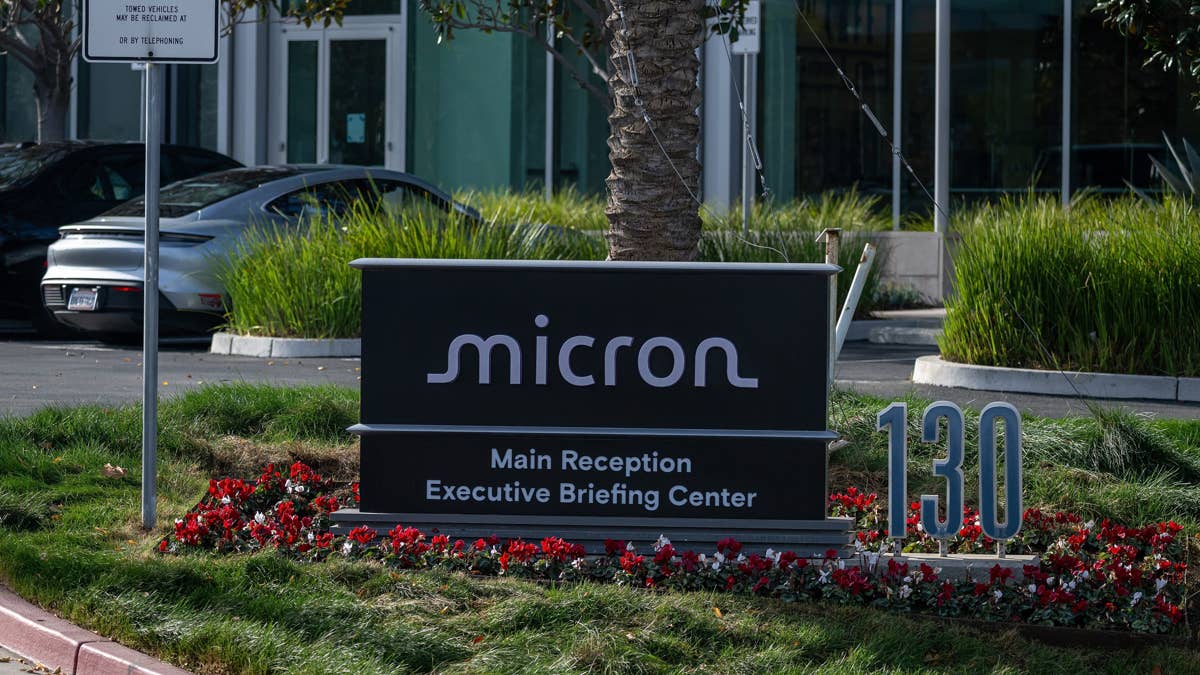
David/Getty Images
What GPU rental prices say about HBM demand right now
One of the more specific data points in the note is GPU rental pricing. Flagship Nvidia GPUs including the A100, H100, and H200 are renting at near all-time highs as of August 2026.
That tells you customers are still generating strong economic returns from AI compute. It also means they’re still willing to pay for the HBM memory integrated into those systems.
TrendForce’s Q3 2026 server DRAM pricing outlook is up 13% to 18% quarter over quarter, according to TrendForce. Spot DRAM and NAND pricing have been running flat to up in recent weeks.
None of the top four hyperscalers said memory pricing had become a constraint on AI deployments during their Q2 earnings calls. The only one that mentioned memory in the context of capex was AWS, and it was about spending more, not less, as TheStreet reported.
There is one concern floating around the market that Arya addresses. Reports suggest Nvidia’s upcoming Rubin Ultra GPU might integrate two compute dies and eight HBM4e stacks per package rather than the planned four dies and 16 stacks. That would halve the HBM content per package.
Arya says investors shouldn’t read too much into it. The HBM content per gigawatt of compute stays the same. Total memory per unit of AI infrastructure output doesn’t shrink, even if the per-package count does.
Long-term contracts and the China threat
Two other structural changes get attention in the note. The first is the shift toward long-term supply agreements. Historically, memory pricing was negotiated quarterly, which drove violent swings in profitability.
Today, both Samsung and Micron are moving toward multi-year agreements covering eventually 50% to 70% of industry capacity.
Bank of America doesn’t claim these contracts prevent downturns. But they reduce how badly uncontrolled supply additions can hurt pricing, which historically has been the main driver of memory price collapses.
The second is CXMT, China’s domestic memory manufacturer that has been rapidly expanding capacity. Some investors see it as a growing threat. Arya doesn’t.
CXMT is focused on commodity DRAM for consumer markets. It doesn’t make HBM3E or HBM4, the advanced memory required for AI accelerators. And it’s unclear whether U.S. companies would even get government approval to source AI memory from Chinese suppliers. The threat is real in commodity memory. In AI memory, Bank of America says it barely registers.
For Arya, the sell-off reflects investors’ positioning for a cycle that hasn’t started yet. The GPU rental data, the hyperscaler spending trajectory, and the pricing outlook all point in the same direction.
The stock’s valuation doesn’t. That gap is what the $1,550 target is built on.
Related: Veteran analyst drops massive Micron valuation prediction